Benjamin Dowling-Sendor writes for the American School Board Journal on "Drawing the Line Between Science and Religion." I can't link to it because it is behind a vendor subscription but I will provide a few items that did not make their way out of the general Kitzmiller recaps.
Dowling-Sendor reminds us that the wording of the revised disclaimer on the textbooks read
Students will be made aware of gaps/problems in Darwin's theory and of other theories of evolution including, but not limited to, intelligent design. Note: Origins of Life is not taught.
The connection that he does not make here, though, is that the "reference book" Of Pandas and People (which I reviewed bit back) goes out of its way to teach origins of life questions. And it does it badly.
Dowling-Sendor also boils down one of the consequences of ID thought that was picked up by Judge Jones:
Second, Jones observed that intelligent design rests on "a false dichotomy, namely that to the extent evolutionary theory is discredited, ID is confirmed."
This is the age-old argument that "creation science" attempted (badly, again) to address in the 1960s: just because your theory is wrong, doesn't make my theory right. What also wasn't widely reported was a much more damning allegation:
He noted, for example, that two board members expressly and repeatedly pushed the other members of the board and school officials to inject creationism into the science curriculum, and that those two board members secretly arranged for the donation of 60 copies of Of Pandas and People to the high school.
Few people like to be snookered, especially by people espousing the value of Christianity. As Dowling-Sendor notes:
In a board election held during the trial, all eight incumbents on the nine-member board who were up for election were defeated.
Wednesday, March 29, 2006


Thursday, March 23, 2006
Update on Lubenow
I am still plowing through Lubenow's Bones of Contention. So far, there are some trends to report. He systematically:
- misinterprets fossils
- gets basic scientific concepts wrong
- makes inappropriate leaps in logic
- makes false analogies
It is difficult to know where to begin. As I noted earlier, there is a problem with EVERY page of the book. More later.
The Archbishop of Canterbury weighs in
The Grey Lady puts out a story in which the Archbishop of Canterbury has come down on the opposite side of ID. NYT login may be necessary. The cleric states:
I think creationism is, in a sense, a kind of category mistake, as if the Bible were a theory like other theories. Whatever the biblical account of creation is, it's not a theory alongside theories. It's not as if the writer of Genesis or whatever sat down and said, 'Well, how am I going to explain all this?'
He also noted that opposing creationism in a curriculum is not the same as talking about how creation came about. Good article.
Update: It seems that NYT has since placed this article behind its "Times Select" wall and it is no longer accessible. That is too bad.
I think creationism is, in a sense, a kind of category mistake, as if the Bible were a theory like other theories. Whatever the biblical account of creation is, it's not a theory alongside theories. It's not as if the writer of Genesis or whatever sat down and said, 'Well, how am I going to explain all this?'
He also noted that opposing creationism in a curriculum is not the same as talking about how creation came about. Good article.
Update: It seems that NYT has since placed this article behind its "Times Select" wall and it is no longer accessible. That is too bad.
Light Posting
Sorry the posting has been light. I have been slammed with getting two anthropology courses finished. I will try to do better.
Saturday, March 18, 2006
Dover, the Movie?
This might be a spoof. One would certainly hope so. Someone apparently thinks that the Dover school board ruling would make powerful cinema. Seems they will make a movie about anything these days.
Hat tip to Marilyn Savitt-Kring
Hat tip to Marilyn Savitt-Kring
Thursday, March 09, 2006
Yes, we are still evolving
Nicholas Wade reports in the NYT of research that demonstrates that we are still evolving. This is not really news. We know that tooth size has dropped an average of 11% since the neolithic period. I am curious to know why the authors have singled out only selection for these traits and not drift coupled with selection, since selection will act more quickly on smaller populations where drift has occured and more slowly on larger populations where there is little drift.
Saturday, March 04, 2006
Oops!
Sorry, I forgot to link the Kirk Johnson piece on the bill in Utah. Here it is:http://www.nytimes.com/2006/02/28/national/28utah.html
Thursday, March 02, 2006
An Uphill Battle Indeed
Kirk Johnson of the Grey Lady reports on the failure of an "Origins of Life" bill to be passed in the Republican-controlled Utah House of Representatives. According to Johnson:
The Origins of Life bill, in its initial form, would have required teachers to issue a disclaimer to their students saying that not all scientists agree about evolution and the origin of species. It did not mention any alternative theory to Darwinism, but was viewed by some supporters and opponents as part of the drive to encourage the teaching of intelligent design, which says that life is too complicated to have evolved without an architect.
That the bill did not pass in a state as conservative as Utah was seen by Americans United for Separation of Church and State as a considerable victory. A spokesman for that organization, Joe Conn, was quoted as saying:
"If the creationists can't win in a state as conservative as Utah, they've got an uphill battle."
Hat tip to R.L. Macklin
The Origins of Life bill, in its initial form, would have required teachers to issue a disclaimer to their students saying that not all scientists agree about evolution and the origin of species. It did not mention any alternative theory to Darwinism, but was viewed by some supporters and opponents as part of the drive to encourage the teaching of intelligent design, which says that life is too complicated to have evolved without an architect.
That the bill did not pass in a state as conservative as Utah was seen by Americans United for Separation of Church and State as a considerable victory. A spokesman for that organization, Joe Conn, was quoted as saying:
"If the creationists can't win in a state as conservative as Utah, they've got an uphill battle."
Hat tip to R.L. Macklin
Wednesday, March 01, 2006
Evolution on Campus
Nathanael Blake, a columnist on Townhall has written a two-part (so far) column on evolution and evangelicals. Here are the links to Part 1 and Part 2. He argues something that I have long thought true--Christians need to make their peace with evolution. Evangelical Christianity made a mistake of incalculable proportions in the 1920s when they chose to reject evolution. This was the time when natural selection was being merged with mathematics, genetics and population biology to form the synthetic theory that we have with us today.
He makes an especially good point that ID exists only to tackle evolution.
Attempts to provide a detailed I.D. position would fracture the coalition into myriad squabbling factions. However, even this tenuous unity is enough to make I.D. into a mighty force in the culture wars. Combating evolution is one of the main goals of the Christian right.
It is almost as if ID proponents simply cannot help themselves. Evolution is too tempting a target. The problem is, as Mr. Blake notes, they don't have the necessary scientific background to tackle it successfully. I am currently on page 90 of Bones of Contention by Marvin Lubenow and it is horrific.
He also notes:
Interpreting Scripture is difficult and given to some uncertainty. Hence there is a lure to fundamentalism, which eliminates doubt by defaulting to the most literal view possible, regardless of whether the text should be read that way.
He makes an especially good point that ID exists only to tackle evolution.
Attempts to provide a detailed I.D. position would fracture the coalition into myriad squabbling factions. However, even this tenuous unity is enough to make I.D. into a mighty force in the culture wars. Combating evolution is one of the main goals of the Christian right.
It is almost as if ID proponents simply cannot help themselves. Evolution is too tempting a target. The problem is, as Mr. Blake notes, they don't have the necessary scientific background to tackle it successfully. I am currently on page 90 of Bones of Contention by Marvin Lubenow and it is horrific.
He also notes:
Interpreting Scripture is difficult and given to some uncertainty. Hence there is a lure to fundamentalism, which eliminates doubt by defaulting to the most literal view possible, regardless of whether the text should be read that way.
While the certainty this confers may be comforting, it makes for sloppy theology and horrible science.
Read both posts. He writes very well.Sorry
Sorry for the lack of posts. I have been slammed at work and my wife pulled a muscle in her back so i have been looking after the kids at night. Things are better now.
Tuesday, February 21, 2006
Slow Going
I am on page 33 of Bones of Contention. This is going to take awhile. So far, there has been either a logical error or a factual error on every single page. Yeeeesh.
The AAAS Gets Involved
The American Association for the Advancement of Science is urging mainline denominations to get involved in fighting "policies that undermine the teaching of evolution."
A clarification
The book by Marvin Lubenow, Bones of Contention, was revised in 2004. In the preface, he write that the new edition is "largely rewritten" and that he now has not hesitated to quote from creation scientists, where appropriate. In keeping with this, the back cover has glowing reviews from four individuals, three of which are main line creationists: Henry Morris, Ken Ham and Tim LaHaye. The fourth, Michael Charney, passed away in 1998, so we have to assume his review is of the previous edition. I am having a heck of a time finding it. My review will take place in a separate web page that will likely be broken down chapter by chapter.
Monday, February 20, 2006
Bones of Contention
Following on the heels of OPAP, in a continuing effort to be as mean to myself as possible, I am going to read the creationist classic Bones of Contention by Marvin Lubenow. The subtitle is " A Creationist Assessment of Human Fossils." Sounds promising, does it not? I will get back to you about it. In the meantime, stay tuned for more news.
Thursday, February 16, 2006
Ohio Vote
It seems that the Ohio Board of Education has decided against the model plan that singled out evolution for critical analysis and suggested the teaching of ID in classrooms. In an NCSE report, the board voted 11-4 to scotch the model.
Of Pandas and People, Part 3
Two of the central concepts in understanding descent with modification are analogy and homology. Analogy is where different anatomical structures are used to solve the same biomechanical problem. An example of analogy are the differences between the bat wing and the bird wing. While these structures share the same function, a cursory examination of each reveals that they are composed of different skeletal elements and are constructed differently. This, in conjunction with the known information that bats are mammals and birds are in the class Aves, strongly suggests that these structures are not evolutionary related. Homology is similarity of structures due to common descent. An example of this would be the primate arm and bat wing, both of which are constructed from the same anatomical features.
The writers of OPAP get this concept wrong from the get go. On page 115, they write:
The Darwinian definition of homology, however, does not rest upon the two parts being identical, or even similar for that matter, in appearance or function. Darwinists have defined homology as correspondence of structure derived from a common primitive origin, a definition that assumes macroevolution to be true.
For starters, it was the overwhelming evidence of homology in the natural world that allowed Darwin to formulate his theory of descent with modification in the first place. The authors correctly state that homology as a concept had been around since before Darwin's time. Darwin simply used the concept of homology, he did not redefine it.
On page 124, they write this about homology:
But consider how limited the usefulness of the concept is; it cannot replace subjective judgments, nor can it deliver us from the influences of our presuppositions. Notice that the truth of Darwinism must be assumed before such an assessment of relationship can be made. Marsupial pouches and bones are considered homologous because it is assumed that the organisms possessing them descended from a common ancestor.
This is exactly backward. The fact that the animals display homologous traits indicates that they share a common ancestor. Linnaeus formulated his binomial taxonomy based on relationships between organisms based on homology. All palaeontologists do is extrapolate that concept into the past to make inferences about descent.
On the next page, they write:
Why were not the North American placentals given the same bones [as the marsupials]? Would an intelligent designer withhold these structures from placentals if they were superior to the placental system? At present we do not know; however, we all recognize that an engineer can choose any of several different engineering solutions to overcome a single design problem.
We don't know? If something has been intelligently designed, it ought to be obvious, like the truck in the middle of the field. If the placental system is better than the marsupial system and yet the marsupial system is the norm in Wallacea (Australia and New Zealand), how intelligent is that? The only reason the marsupial system is the norm in Wallacea is that the Wallace Trench prevents placentals from entering the region. Where they are transported to the region by other (more modern) means, they outcompete the marsupials for resources--hence the "Rabbit-Proof Fence."
In the "A Note to Teachers" section, the authors state that:
Since the 1970s, for example, scientific criticisms of the long-dominant neo-Darwinian theory of evolution (which combines classical Darwinism with Mendelian genetics) have surfaced with increasing regularity.
The sources the authors cite are an amazingly diverse lot. Four of them are creationist sources, Six are general sources and several are journal articles. Three were published prior to 1970. I have read most of the journal articles and they do not criticize the domiant neo-Darwinian theory of evolution as defined here. There are questions about the tempo and mode of evolution but all evolutionary biologists assume that genetics play an important role. The authors do not define "classical Darwinism." This is a standard creationist ploy--make a blanket statement and then support it with references that are either outdated or do not necessarily support what they are saying.
On page 154, the authors state:
In the spirit of good, honest science, Pandas makes no bones about being a text with a point of view. Because it was intended to be a supplemental text, the authors saw no value in simply rehashing the orthodox accounts covered by basal textbooks.
"In the spirit of good, honest science..."? Since when is it good, honest science to promote a particular viewpoint? Science goes where the evidence leads, not where you hope it will lead. Then you report what you find and integrate it into a larger body of knowledge about a particular field.
On page 155, the authors pull the old "double shuffle." They state:
Many people assert that evolution in this second sense [descent with modification] is a fact, just as gravity is a fact. But the two situations are hardly analagous . The fact of gravity can be verified simply by dropping a pencil--an experiment anyone can perform. Common ancestry, however, cannot be directly verified by such an experiment.
In the first part of this section, the authors mention "descent with modification." In the last part, they talk about " common ancestry." The two are not the same. Descent with modification can be observed in just about any population of organisms. A change in gene frequencies from one generation to the next is "descent with modification." This is basic evolutionary theory. It is the theoretical extrapolation through time across the species boundary that the authors object to and they have lumped it all together.
There is this goody on page 160:
For example, the mutational events that allegedly produced reptiles, birds, mammals, and even humans have never been observed--nor will they ever be observed. Similarly, the transitional life forms that occupy the branching-points on Darwin's tree of life are also unobservable. Transitional forms exist now only as theoretical entities that make possible a coherent Darwinian account of how present-day species originated.
By this reasoning, no fossil form could ever be transitional. So when we find Archaeopteryx, with its reptilian body plan and hollow arm bones and feathers, this is not transitional. It is simply a form of animal that was created by divine fiat--despite what its existence STRONGLY suggests.
Other scientists have reviewed this book and a list of those reviews can be found here. These usually proceed from specific subject areas of expertise but, when taken together, form a consistent theme: OPAP is bad science and a bad textbook. If this is the current state of Intelligent Design education, then it surely does not belong in a science classroom, First Amendment issues aside. Reading this book was a truly depressing experience and it shows that many creationists have made little to no progress at understanding basic biological concepts in the last seventy years. If your child is in a school district that is using this book or you know of one, alert them immediately!! This book should be avoided.
The writers of OPAP get this concept wrong from the get go. On page 115, they write:
The Darwinian definition of homology, however, does not rest upon the two parts being identical, or even similar for that matter, in appearance or function. Darwinists have defined homology as correspondence of structure derived from a common primitive origin, a definition that assumes macroevolution to be true.
For starters, it was the overwhelming evidence of homology in the natural world that allowed Darwin to formulate his theory of descent with modification in the first place. The authors correctly state that homology as a concept had been around since before Darwin's time. Darwin simply used the concept of homology, he did not redefine it.
On page 124, they write this about homology:
But consider how limited the usefulness of the concept is; it cannot replace subjective judgments, nor can it deliver us from the influences of our presuppositions. Notice that the truth of Darwinism must be assumed before such an assessment of relationship can be made. Marsupial pouches and bones are considered homologous because it is assumed that the organisms possessing them descended from a common ancestor.
This is exactly backward. The fact that the animals display homologous traits indicates that they share a common ancestor. Linnaeus formulated his binomial taxonomy based on relationships between organisms based on homology. All palaeontologists do is extrapolate that concept into the past to make inferences about descent.
On the next page, they write:
Why were not the North American placentals given the same bones [as the marsupials]? Would an intelligent designer withhold these structures from placentals if they were superior to the placental system? At present we do not know; however, we all recognize that an engineer can choose any of several different engineering solutions to overcome a single design problem.
We don't know? If something has been intelligently designed, it ought to be obvious, like the truck in the middle of the field. If the placental system is better than the marsupial system and yet the marsupial system is the norm in Wallacea (Australia and New Zealand), how intelligent is that? The only reason the marsupial system is the norm in Wallacea is that the Wallace Trench prevents placentals from entering the region. Where they are transported to the region by other (more modern) means, they outcompete the marsupials for resources--hence the "Rabbit-Proof Fence."
In the "A Note to Teachers" section, the authors state that:
Since the 1970s, for example, scientific criticisms of the long-dominant neo-Darwinian theory of evolution (which combines classical Darwinism with Mendelian genetics) have surfaced with increasing regularity.
The sources the authors cite are an amazingly diverse lot. Four of them are creationist sources, Six are general sources and several are journal articles. Three were published prior to 1970. I have read most of the journal articles and they do not criticize the domiant neo-Darwinian theory of evolution as defined here. There are questions about the tempo and mode of evolution but all evolutionary biologists assume that genetics play an important role. The authors do not define "classical Darwinism." This is a standard creationist ploy--make a blanket statement and then support it with references that are either outdated or do not necessarily support what they are saying.
On page 154, the authors state:
In the spirit of good, honest science, Pandas makes no bones about being a text with a point of view. Because it was intended to be a supplemental text, the authors saw no value in simply rehashing the orthodox accounts covered by basal textbooks.
"In the spirit of good, honest science..."? Since when is it good, honest science to promote a particular viewpoint? Science goes where the evidence leads, not where you hope it will lead. Then you report what you find and integrate it into a larger body of knowledge about a particular field.
On page 155, the authors pull the old "double shuffle." They state:
Many people assert that evolution in this second sense [descent with modification] is a fact, just as gravity is a fact. But the two situations are hardly analagous . The fact of gravity can be verified simply by dropping a pencil--an experiment anyone can perform. Common ancestry, however, cannot be directly verified by such an experiment.
In the first part of this section, the authors mention "descent with modification." In the last part, they talk about " common ancestry." The two are not the same. Descent with modification can be observed in just about any population of organisms. A change in gene frequencies from one generation to the next is "descent with modification." This is basic evolutionary theory. It is the theoretical extrapolation through time across the species boundary that the authors object to and they have lumped it all together.
There is this goody on page 160:
For example, the mutational events that allegedly produced reptiles, birds, mammals, and even humans have never been observed--nor will they ever be observed. Similarly, the transitional life forms that occupy the branching-points on Darwin's tree of life are also unobservable. Transitional forms exist now only as theoretical entities that make possible a coherent Darwinian account of how present-day species originated.
By this reasoning, no fossil form could ever be transitional. So when we find Archaeopteryx, with its reptilian body plan and hollow arm bones and feathers, this is not transitional. It is simply a form of animal that was created by divine fiat--despite what its existence STRONGLY suggests.
Other scientists have reviewed this book and a list of those reviews can be found here. These usually proceed from specific subject areas of expertise but, when taken together, form a consistent theme: OPAP is bad science and a bad textbook. If this is the current state of Intelligent Design education, then it surely does not belong in a science classroom, First Amendment issues aside. Reading this book was a truly depressing experience and it shows that many creationists have made little to no progress at understanding basic biological concepts in the last seventy years. If your child is in a school district that is using this book or you know of one, alert them immediately!! This book should be avoided.
Wednesday, February 15, 2006
Father Jonathan Morris on Foxnews
Father Jonathan Morris, On Foxnews tackles the ID issue in decidedly antagonistic tone. He writes:
Unlike thinkers of ages past, who intertwined gracefully some elements of philosophy with the natural sciences, today we prefer — for reasons of method — to separate one from the other. In these categories, the competence of modern science accepts only what we can observe and measure (empirical evidence). Questions like, “What’s the essence of it?” and “What’s it for?” are sent down the hall to the philosophy department. And that’s fair.
He then ties it neatly with this gem:
Intelligent design theory asks just that type of “down the hall” question. Its proponents claim that a good scientist can’t look at the complexity of the human eye without asking himself, “How did that happen?,” and responding with the answer, “I don’t know, but I do know that it didn’t just happen; there must be intelligence behind that design.” The affirmation is quite logical, but the evidence would be philosophical, not empirical, and for that reason it belongs down the hall.
I might quibble with his definition of Darwinism, but otherwise, he is smack on the money.
Unlike thinkers of ages past, who intertwined gracefully some elements of philosophy with the natural sciences, today we prefer — for reasons of method — to separate one from the other. In these categories, the competence of modern science accepts only what we can observe and measure (empirical evidence). Questions like, “What’s the essence of it?” and “What’s it for?” are sent down the hall to the philosophy department. And that’s fair.
He then ties it neatly with this gem:
Intelligent design theory asks just that type of “down the hall” question. Its proponents claim that a good scientist can’t look at the complexity of the human eye without asking himself, “How did that happen?,” and responding with the answer, “I don’t know, but I do know that it didn’t just happen; there must be intelligence behind that design.” The affirmation is quite logical, but the evidence would be philosophical, not empirical, and for that reason it belongs down the hall.
I might quibble with his definition of Darwinism, but otherwise, he is smack on the money.
Ohio Reverses its Stance on ID
It seems that the Ohio Board of Education is rethinking its stance on the teaching of ID in classrooms. As the NYT article (free subscription possibly required) by Jodi Rudoren notes, however, such a move seems to go against what is known of popular opinion in Ohio:
On Monday, the institute released a Zogby International poll it had commissioned showing that 69 percent of Ohio voters believed that scientific evidence against evolution should be included in curriculums, and 76 percent agreed that "students should also be able to learn about scientific evidence that points to an intelligent design of life." The institute has also proffered letters from two science professors supporting Ohio's standards and model lesson plan.
The problem is that does not change the nature of the underlying model plan:
Besides the Dover decision, the disclosure in December of documents detailing internal discussions of the lesson plan helped revive debate here. Obtained by Americans United for the Separation of Church and State, a group considering a suit on the plan, the documents show that department scientists and outside experts condemned the lesson as "a lie," "crackpot," "religious," "creationism" and "an insult to science."
This is especially true is they are using Of Pandas and People. The third part of that review should be up today. As my brother Paul would say, "You can't make chicken salad out of chicken crap."
On Monday, the institute released a Zogby International poll it had commissioned showing that 69 percent of Ohio voters believed that scientific evidence against evolution should be included in curriculums, and 76 percent agreed that "students should also be able to learn about scientific evidence that points to an intelligent design of life." The institute has also proffered letters from two science professors supporting Ohio's standards and model lesson plan.
The problem is that does not change the nature of the underlying model plan:
Besides the Dover decision, the disclosure in December of documents detailing internal discussions of the lesson plan helped revive debate here. Obtained by Americans United for the Separation of Church and State, a group considering a suit on the plan, the documents show that department scientists and outside experts condemned the lesson as "a lie," "crackpot," "religious," "creationism" and "an insult to science."
This is especially true is they are using Of Pandas and People. The third part of that review should be up today. As my brother Paul would say, "You can't make chicken salad out of chicken crap."
Tuesday, February 14, 2006
Darwin Day at Tennessee
Darwin Day has come and gone and was a rousing success. Dr. Tim Berra spoke on Charles Darwin Thursday Night and then his Australian project, the Nurseryfish, on Friday. He also pointed those present to a web site called ActionBioscience.org that is engaged in promoting science education and is a wealth of information on the basics of evolutionary biology, biodiversity, biotechnology and current issues. It is highly recommended.
Thursday, February 09, 2006
Of Pandas and People, Part 2
This is part 2 of my short review of the abyssmal book Of Pandas and People, the preferred textbook of the Discovery Institute. We'll dive right back into the chapter on the fossil record.
On Page 98, the authors write:
The intelligent design hypothesis is in agreement with the face value interpretation and accepts the gaps [in the fossil record] as a generally true reflection of biology and natural history. A growing number of scientists who study the fossil record are concluding that the structural differences between the major types of organisms reflect life as it was for that era.
Herein lies a major problem with the book. Who is "a growing number?" The writers do not tell us. No citation is provided at all, as if they only want us to take their word for it. Throughout the book, there is a startling lack of supporting citations and, it is my opinion that had this book been submitted to a major science publisher, it would have been returned as unpublishable until the missing citations were added. This represents sloppy work and poor attention to detail.
On page 100, we find the following:
Some scientists have arrived at this view [that ID is the correct explanation for the fossil record] since fossil forms first appear in the rock record with their distinctive features intact, and apprently fully functional, rather than gradually developing. No creatures with a partial wing or partial eye are known.
Where to start. First, the same problem mentioned above: "Some scientists." Who in God's green earth are they talking about? I don't know anyone who subscribes to this view of the fossil record. Once again, no citation.
Second, fossils do not first appear in the rock record with their distinctive features intact. As noted above, this proceeds from a standard creationist view of the fossil record that has been rebutted too many times to count.
Third, the idea that organisms would appear with partial anything demonstrates a poor understanding of how evolution works. This idea, which is the central focus of William Dembski's No Free Lunch, incorrectly assumes that organisms are "discrete combinatorial objects," in which all features of a species are regarded as having appeared at the same time. As the reviewers of that book noted, that is not how evolution works. There is not a single fossil example in which all of a particular set of features indicative of a species as a whole appeared at once.
On page 107, we get to the human fossil record. On the second side of the page, the authors write:
Before looking at the fossils recently proposed to be human ancestors, it is well to keep a few points in mind. First, comparatively few hominid fossil remains have ever been found.
What do the authors mean by "comparatively few?" How many would be "a lot?" I can think of at least 100 complete crania off the top of my head and several hundred more that are at least 50% complete. Add to this several thousands of incomplete remains and you have a fair number of fossils. Is this optimal? No, obviously we would like to have more. But it is enough to make some pretty good assessments of human evolutionary history. And more fossils are being discovered all the time. In the last five years, the origin of the human line has been pushed back two million years by the discovery of fossil remains in Chad and the Afar Triangle.
Back to the book. On page 110, they state:
Less attention has been given to the first appearance of morphologically modern humans in Africa and the Middle East, because of their recency, but these may be quite important discoveries.
Were the authors not paying attention? No fewer than five articles in Time, Newsweek, National Geographic, Science News and Scientific American were published on this topic during 1988 and 1989. And that was just in the mainstream magazines. At least twenty articles showed up in academic journals on these hominids during the same time period. Of course they were important!
On p. 111, the authors write:
The best information we can seek about man's ancestors is that which tells us, not what they looked like, but what they did and how they behaved. Of course, such information is often very fragmentary if found at all, but it is the most important data for which to search.
"...if found at all?" Archaeological information abounds. It is more common than human fossil remains. Every area of the Old World has numerous sites with continuous records of habitation that often extend sixty or seventy thousand years. In the Middle East, one of the persistent questions is how the early modern humans and the Neandertals there interacted. One of the clues is that the abundant archaeological remains at these sites indicates a similar lithic strategy. Not a single worker in this area throws up his or her hands and says, "Boy I sure wish I had more archaeological remains to work with!"
On pages 112 and 113, there is this bombshell:
Darwinists are convinced that Homo erectus was nearly human and directly ancestral to man. Design adherents, however, regard Homo erectus, as well as the other hominids discussed in this section, as little more than apes, and point instead to the abrupt appearance of the culture and patterns of behavior which distinguish man from the apes.
This statement reveals that Design adherents have adopted all of the old, tired creationist arguments about the human fossil record. The obvious, observable fact that the fossils are considerably more than apes seems to have escaped the authors of this book.
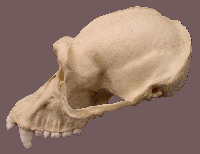
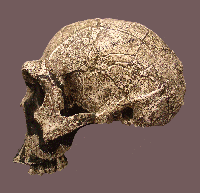
Here we have a lateral view of a chimpanzee skull on the left and a cast of the Homo erectus specimen KNM ER 3733. Can you tell the difference between the two? I thought so.
A continual improvement in stone tools assemblages and traditions from Australopithecus to Homo habilis to Homo erectus to Homo sapiens is well-documented in the geological record and books and scientific papers abound in the literature based on these data.
The section on the fossil record can only described as incompetently written at best and, given the wealth of data and literature to the contrary, intentionally misleading at worst. On this chapter alone, Of Pandas and People fails miserably as a reference work.
Part Three of my review to come shortly.
On Page 98, the authors write:
The intelligent design hypothesis is in agreement with the face value interpretation and accepts the gaps [in the fossil record] as a generally true reflection of biology and natural history. A growing number of scientists who study the fossil record are concluding that the structural differences between the major types of organisms reflect life as it was for that era.
Herein lies a major problem with the book. Who is "a growing number?" The writers do not tell us. No citation is provided at all, as if they only want us to take their word for it. Throughout the book, there is a startling lack of supporting citations and, it is my opinion that had this book been submitted to a major science publisher, it would have been returned as unpublishable until the missing citations were added. This represents sloppy work and poor attention to detail.
On page 100, we find the following:
Some scientists have arrived at this view [that ID is the correct explanation for the fossil record] since fossil forms first appear in the rock record with their distinctive features intact, and apprently fully functional, rather than gradually developing. No creatures with a partial wing or partial eye are known.
Where to start. First, the same problem mentioned above: "Some scientists." Who in God's green earth are they talking about? I don't know anyone who subscribes to this view of the fossil record. Once again, no citation.
Second, fossils do not first appear in the rock record with their distinctive features intact. As noted above, this proceeds from a standard creationist view of the fossil record that has been rebutted too many times to count.
Third, the idea that organisms would appear with partial anything demonstrates a poor understanding of how evolution works. This idea, which is the central focus of William Dembski's No Free Lunch, incorrectly assumes that organisms are "discrete combinatorial objects," in which all features of a species are regarded as having appeared at the same time. As the reviewers of that book noted, that is not how evolution works. There is not a single fossil example in which all of a particular set of features indicative of a species as a whole appeared at once.
On page 107, we get to the human fossil record. On the second side of the page, the authors write:
Before looking at the fossils recently proposed to be human ancestors, it is well to keep a few points in mind. First, comparatively few hominid fossil remains have ever been found.
What do the authors mean by "comparatively few?" How many would be "a lot?" I can think of at least 100 complete crania off the top of my head and several hundred more that are at least 50% complete. Add to this several thousands of incomplete remains and you have a fair number of fossils. Is this optimal? No, obviously we would like to have more. But it is enough to make some pretty good assessments of human evolutionary history. And more fossils are being discovered all the time. In the last five years, the origin of the human line has been pushed back two million years by the discovery of fossil remains in Chad and the Afar Triangle.
Back to the book. On page 110, they state:
Less attention has been given to the first appearance of morphologically modern humans in Africa and the Middle East, because of their recency, but these may be quite important discoveries.
Were the authors not paying attention? No fewer than five articles in Time, Newsweek, National Geographic, Science News and Scientific American were published on this topic during 1988 and 1989. And that was just in the mainstream magazines. At least twenty articles showed up in academic journals on these hominids during the same time period. Of course they were important!
On p. 111, the authors write:
The best information we can seek about man's ancestors is that which tells us, not what they looked like, but what they did and how they behaved. Of course, such information is often very fragmentary if found at all, but it is the most important data for which to search.
"...if found at all?" Archaeological information abounds. It is more common than human fossil remains. Every area of the Old World has numerous sites with continuous records of habitation that often extend sixty or seventy thousand years. In the Middle East, one of the persistent questions is how the early modern humans and the Neandertals there interacted. One of the clues is that the abundant archaeological remains at these sites indicates a similar lithic strategy. Not a single worker in this area throws up his or her hands and says, "Boy I sure wish I had more archaeological remains to work with!"
On pages 112 and 113, there is this bombshell:
Darwinists are convinced that Homo erectus was nearly human and directly ancestral to man. Design adherents, however, regard Homo erectus, as well as the other hominids discussed in this section, as little more than apes, and point instead to the abrupt appearance of the culture and patterns of behavior which distinguish man from the apes.
This statement reveals that Design adherents have adopted all of the old, tired creationist arguments about the human fossil record. The obvious, observable fact that the fossils are considerably more than apes seems to have escaped the authors of this book.
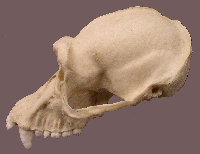

Here we have a lateral view of a chimpanzee skull on the left and a cast of the Homo erectus specimen KNM ER 3733. Can you tell the difference between the two? I thought so.
A continual improvement in stone tools assemblages and traditions from Australopithecus to Homo habilis to Homo erectus to Homo sapiens is well-documented in the geological record and books and scientific papers abound in the literature based on these data.
The section on the fossil record can only described as incompetently written at best and, given the wealth of data and literature to the contrary, intentionally misleading at worst. On this chapter alone, Of Pandas and People fails miserably as a reference work.
Part Three of my review to come shortly.
Subscribe to:
Posts (Atom)