Tuesday, February 14, 2006
Darwin Day at Tennessee
Darwin Day has come and gone and was a rousing success. Dr. Tim Berra spoke on Charles Darwin Thursday Night and then his Australian project, the Nurseryfish, on Friday. He also pointed those present to a web site called ActionBioscience.org that is engaged in promoting science education and is a wealth of information on the basics of evolutionary biology, biodiversity, biotechnology and current issues. It is highly recommended.


Thursday, February 09, 2006
Of Pandas and People, Part 2
This is part 2 of my short review of the abyssmal book Of Pandas and People, the preferred textbook of the Discovery Institute. We'll dive right back into the chapter on the fossil record.
On Page 98, the authors write:
The intelligent design hypothesis is in agreement with the face value interpretation and accepts the gaps [in the fossil record] as a generally true reflection of biology and natural history. A growing number of scientists who study the fossil record are concluding that the structural differences between the major types of organisms reflect life as it was for that era.
Herein lies a major problem with the book. Who is "a growing number?" The writers do not tell us. No citation is provided at all, as if they only want us to take their word for it. Throughout the book, there is a startling lack of supporting citations and, it is my opinion that had this book been submitted to a major science publisher, it would have been returned as unpublishable until the missing citations were added. This represents sloppy work and poor attention to detail.
On page 100, we find the following:
Some scientists have arrived at this view [that ID is the correct explanation for the fossil record] since fossil forms first appear in the rock record with their distinctive features intact, and apprently fully functional, rather than gradually developing. No creatures with a partial wing or partial eye are known.
Where to start. First, the same problem mentioned above: "Some scientists." Who in God's green earth are they talking about? I don't know anyone who subscribes to this view of the fossil record. Once again, no citation.
Second, fossils do not first appear in the rock record with their distinctive features intact. As noted above, this proceeds from a standard creationist view of the fossil record that has been rebutted too many times to count.
Third, the idea that organisms would appear with partial anything demonstrates a poor understanding of how evolution works. This idea, which is the central focus of William Dembski's No Free Lunch, incorrectly assumes that organisms are "discrete combinatorial objects," in which all features of a species are regarded as having appeared at the same time. As the reviewers of that book noted, that is not how evolution works. There is not a single fossil example in which all of a particular set of features indicative of a species as a whole appeared at once.
On page 107, we get to the human fossil record. On the second side of the page, the authors write:
Before looking at the fossils recently proposed to be human ancestors, it is well to keep a few points in mind. First, comparatively few hominid fossil remains have ever been found.
What do the authors mean by "comparatively few?" How many would be "a lot?" I can think of at least 100 complete crania off the top of my head and several hundred more that are at least 50% complete. Add to this several thousands of incomplete remains and you have a fair number of fossils. Is this optimal? No, obviously we would like to have more. But it is enough to make some pretty good assessments of human evolutionary history. And more fossils are being discovered all the time. In the last five years, the origin of the human line has been pushed back two million years by the discovery of fossil remains in Chad and the Afar Triangle.
Back to the book. On page 110, they state:
Less attention has been given to the first appearance of morphologically modern humans in Africa and the Middle East, because of their recency, but these may be quite important discoveries.
Were the authors not paying attention? No fewer than five articles in Time, Newsweek, National Geographic, Science News and Scientific American were published on this topic during 1988 and 1989. And that was just in the mainstream magazines. At least twenty articles showed up in academic journals on these hominids during the same time period. Of course they were important!
On p. 111, the authors write:
The best information we can seek about man's ancestors is that which tells us, not what they looked like, but what they did and how they behaved. Of course, such information is often very fragmentary if found at all, but it is the most important data for which to search.
"...if found at all?" Archaeological information abounds. It is more common than human fossil remains. Every area of the Old World has numerous sites with continuous records of habitation that often extend sixty or seventy thousand years. In the Middle East, one of the persistent questions is how the early modern humans and the Neandertals there interacted. One of the clues is that the abundant archaeological remains at these sites indicates a similar lithic strategy. Not a single worker in this area throws up his or her hands and says, "Boy I sure wish I had more archaeological remains to work with!"
On pages 112 and 113, there is this bombshell:
Darwinists are convinced that Homo erectus was nearly human and directly ancestral to man. Design adherents, however, regard Homo erectus, as well as the other hominids discussed in this section, as little more than apes, and point instead to the abrupt appearance of the culture and patterns of behavior which distinguish man from the apes.
This statement reveals that Design adherents have adopted all of the old, tired creationist arguments about the human fossil record. The obvious, observable fact that the fossils are considerably more than apes seems to have escaped the authors of this book.
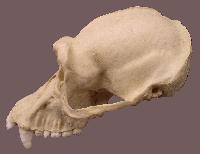
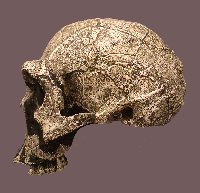
Here we have a lateral view of a chimpanzee skull on the left and a cast of the Homo erectus specimen KNM ER 3733. Can you tell the difference between the two? I thought so.
A continual improvement in stone tools assemblages and traditions from Australopithecus to Homo habilis to Homo erectus to Homo sapiens is well-documented in the geological record and books and scientific papers abound in the literature based on these data.
The section on the fossil record can only described as incompetently written at best and, given the wealth of data and literature to the contrary, intentionally misleading at worst. On this chapter alone, Of Pandas and People fails miserably as a reference work.
Part Three of my review to come shortly.
On Page 98, the authors write:
The intelligent design hypothesis is in agreement with the face value interpretation and accepts the gaps [in the fossil record] as a generally true reflection of biology and natural history. A growing number of scientists who study the fossil record are concluding that the structural differences between the major types of organisms reflect life as it was for that era.
Herein lies a major problem with the book. Who is "a growing number?" The writers do not tell us. No citation is provided at all, as if they only want us to take their word for it. Throughout the book, there is a startling lack of supporting citations and, it is my opinion that had this book been submitted to a major science publisher, it would have been returned as unpublishable until the missing citations were added. This represents sloppy work and poor attention to detail.
On page 100, we find the following:
Some scientists have arrived at this view [that ID is the correct explanation for the fossil record] since fossil forms first appear in the rock record with their distinctive features intact, and apprently fully functional, rather than gradually developing. No creatures with a partial wing or partial eye are known.
Where to start. First, the same problem mentioned above: "Some scientists." Who in God's green earth are they talking about? I don't know anyone who subscribes to this view of the fossil record. Once again, no citation.
Second, fossils do not first appear in the rock record with their distinctive features intact. As noted above, this proceeds from a standard creationist view of the fossil record that has been rebutted too many times to count.
Third, the idea that organisms would appear with partial anything demonstrates a poor understanding of how evolution works. This idea, which is the central focus of William Dembski's No Free Lunch, incorrectly assumes that organisms are "discrete combinatorial objects," in which all features of a species are regarded as having appeared at the same time. As the reviewers of that book noted, that is not how evolution works. There is not a single fossil example in which all of a particular set of features indicative of a species as a whole appeared at once.
On page 107, we get to the human fossil record. On the second side of the page, the authors write:
Before looking at the fossils recently proposed to be human ancestors, it is well to keep a few points in mind. First, comparatively few hominid fossil remains have ever been found.
What do the authors mean by "comparatively few?" How many would be "a lot?" I can think of at least 100 complete crania off the top of my head and several hundred more that are at least 50% complete. Add to this several thousands of incomplete remains and you have a fair number of fossils. Is this optimal? No, obviously we would like to have more. But it is enough to make some pretty good assessments of human evolutionary history. And more fossils are being discovered all the time. In the last five years, the origin of the human line has been pushed back two million years by the discovery of fossil remains in Chad and the Afar Triangle.
Back to the book. On page 110, they state:
Less attention has been given to the first appearance of morphologically modern humans in Africa and the Middle East, because of their recency, but these may be quite important discoveries.
Were the authors not paying attention? No fewer than five articles in Time, Newsweek, National Geographic, Science News and Scientific American were published on this topic during 1988 and 1989. And that was just in the mainstream magazines. At least twenty articles showed up in academic journals on these hominids during the same time period. Of course they were important!
On p. 111, the authors write:
The best information we can seek about man's ancestors is that which tells us, not what they looked like, but what they did and how they behaved. Of course, such information is often very fragmentary if found at all, but it is the most important data for which to search.
"...if found at all?" Archaeological information abounds. It is more common than human fossil remains. Every area of the Old World has numerous sites with continuous records of habitation that often extend sixty or seventy thousand years. In the Middle East, one of the persistent questions is how the early modern humans and the Neandertals there interacted. One of the clues is that the abundant archaeological remains at these sites indicates a similar lithic strategy. Not a single worker in this area throws up his or her hands and says, "Boy I sure wish I had more archaeological remains to work with!"
On pages 112 and 113, there is this bombshell:
Darwinists are convinced that Homo erectus was nearly human and directly ancestral to man. Design adherents, however, regard Homo erectus, as well as the other hominids discussed in this section, as little more than apes, and point instead to the abrupt appearance of the culture and patterns of behavior which distinguish man from the apes.
This statement reveals that Design adherents have adopted all of the old, tired creationist arguments about the human fossil record. The obvious, observable fact that the fossils are considerably more than apes seems to have escaped the authors of this book.
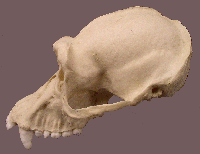

Here we have a lateral view of a chimpanzee skull on the left and a cast of the Homo erectus specimen KNM ER 3733. Can you tell the difference between the two? I thought so.
A continual improvement in stone tools assemblages and traditions from Australopithecus to Homo habilis to Homo erectus to Homo sapiens is well-documented in the geological record and books and scientific papers abound in the literature based on these data.
The section on the fossil record can only described as incompetently written at best and, given the wealth of data and literature to the contrary, intentionally misleading at worst. On this chapter alone, Of Pandas and People fails miserably as a reference work.
Part Three of my review to come shortly.
Wednesday, February 08, 2006
Darwin Day at UT
Darwin Day celebrations are in full swing now. Tonight there is a talk by the Rev. Michael Dowd called "The Gospel According to Evolution" at 7 at the Tennessee Universalist Church and tomorrow night, Dr. Timothy Berra will talk on "Charles Darwin, the Man" at the Cox Auditorium at 7. Come if you can.
Tuesday, February 07, 2006
Of Pandas and People
I have finished Reading Of Pandas and People. To recap: in the Dover School Board ruling, it was revealed that the disclaimer read to the high school ninth grade biology classes reads, in part:
Intelligent Design is an explanation of the origin of life that differs from Darwin’s view. The reference book, Of Pandas and People, is available for students who might be interested in gaining an understanding of what Intelligent Design actually involves.
How good of a reference book is Of Pandas and People? Ladies and gentlemen, it is hands down awful. I do not have the time or space to address all of the problems in the book. That has been done beautifully by Frank Sonleitner here. I will only touch on some of the major errors I found.
The first glaring error is that, while it is being used as a text that promotes an alternative to evolutionary theory, the central focus of the introduction and first section is biopoesis, the origin of life from non-life. Evolutionary theory expressly does not address this issue. Evolution is "descent with modification." It has to have something living to work with. The section on biopoesis is, therefore, irrelevant.
On page 7, the writers state:
To put it another way, breeders can produce sweeter corn or fatter cattle, but they have not turned corn into another kind of plant or cattle into another kind of animal.
Wrong. Broccoli is an intentionally bred offshoot from an ancestral cabbage possibly during the neolithic period. While they are both in the family Brassicaceae, broccoli does not interbreed with any current species of cabbage.
The writers use an analogy of a truck discovered by a native tribe that is similar in vein to that used by William Paley (although no mention of Paley's original example of the watch is given). They suggest that the natives would conclude that it is designed. This sidesteps the possibility that they might conclude no such thing. There are examples of natural features that show the appearance of design because they resemble things that we KNOW are designed. In fact, the natives might simply think that it represents a part of nature that they have never encountered before.
In the opening section in the chapter "The Fossil Record", the authors describe the nature of science. They state that, while there is science based on experiments, Darwin's theory is:
...very different from most other scientific theories. It is a theory about unique past events, events that have come and gone. However life originated in the first place, by intelligent design or spontaneous generation, however the giraffe or aardvark originated, they are not "re-originating." These are one time events.
There are several problems with this statement. Amid the persistent misunderstanding of the nature of evolutionary theory (it does not deal with the origin of life), the authors are dismissing large branches of organized, carefully practiced science, namely palaeontology, astronomy, geology, zoology and many others that don't readily come to mind. Essentially all of the "predictive" sciences. While these are mentioned in the next section, their integrity is sharply impugned. Using the analogy of a murder investigation, the authors write:
The case built on circumstantional evidence is not proof, though it may sound plausible and incriminating. Even so, the jury's belief that [the defendent] Smith is guilty may be more a product of their subjective feelings than they realize. That is why Smith is entitled to defense counsel, so that both sides of the issue can be considered.
Aside from the fact that science doesn't deal in "proof" (that is a pretty basic concept), all of the historical, or predictive sciences have always had their arguments deliberated for their veracity. That is basic to science of any kind, historical or otherwise.
Following this section, three "major" features of the fossil record are noted. They are, briefly: 1. the vast majority of known phyla appeared within a brief period of time, 2. most fossils appear to change little over the course of their history, and 3. Fossils appear fully formed and there is a "conspicuous lack of evidence of graded series of in-between fossils. Instead, numerous gaps exist throughout the fossil record."
Because so much of the rest of the book proceeds from these three observations, it is important to evaluate them.
1. This is not true. Not all phyla are present at the beginning of the Cambrian. New phyla continue to show up after the Cambrian
2. This is only partly true. There are many instances of stasis in the fossil record, but there are also many instances of persistent change over the course of a lineage and other lines that appear to change very quickly. There are other instances of anagenesis--accumulated change in one species leading to a new species.
3. This is the biggest howler in the book. Here, it is evident that the authors of this book have consulted only creationist sources for their information. The notion that there are no transitional fossils in the fossil record is the single most persistent canard in the creationist arsenal. Despite the wealth of information to the contrary, this statement and similar ones continue to appear in creationist literature and, worse, gets recycled within that literature.
Transitional forms abound. George Gaylord Simpson records an almost continuous record of species in the horses. The syapsid group of reptiles are also called "mammal-like reptiles" for exactly that reason. Fossils of these species display characteristics of both mammals and reptiles. As one moves through the mesozoic, fossils in this class have fewer reptilian characteristics and more mammalian ones.
The human fossil record is replete with transitional forms. In fact, that is the norm. Often, different researchers will disagree on where one particular fossil ought to be put (Homo erectus vs. Homo ergaster) not because of which characteristics are present, but because of a disagreement over which characteristics are more important phylogenetically.
I will continue this in the next post.
Monday, February 06, 2006
Sky Guy on Evolution
Sky Guy in the Knoxville News Sentinel (free subscription required), tackles evolution in advance of Darwin Day here at UT. He uses exactly the illustration I often use when talking with people about evolution:
Consider, for example, gravitation. That gravity exists is a fact. What it is and how it acts is a theory. Albert Einstein expanded Isaac Newton's work, and modern developments in physics are acting to change the theory even further. But no matter how gravitational theory changes, gravity is still a fact.
The piece is a bit scattershot but informative.
Friday, February 03, 2006
"Intelligent Falling"
The Onion reports on a new take on Intelligent Design, known as "Intelligent Falling." I leave it to the reader to determine how serious the writers are.
Evolution in the Lab
Scientists have forced evolution to occur in caterpillars. This story from Fox News relates the attempts to alter the color of the caterpillars over time by subjecting them to different environmental stresses. As is noted:
Because the variations are based on temperatures, and thus in the wild would be dependent on seasons, the two types would tend to occur at different times of the year and may never meet in nature, he said.
The next step, the researchers said, is to see if the variations do indeed occur in the wild.
The researchers are quick to note also that this appears to have no selective bearing on the caterpillars, themselves. Interesting.
Sorry about the silence
Blogging has been light. I am digesting Of Pandas and People, which figured so heavily into the Dover School Board decision. So far, I am underwhelmed.
Monday, January 23, 2006
NYT: When Cosmologies Collide
The Grey Lady has yet another article on ID, called "When Cosmologies Collide." This is an article on competing philosophies and the author, Judith Shulevitz, comes out with her main point fairly early:
The judge was echoing a position taken by scientific expert witnesses, who had testified that science is a method, not a creed - a way of finding things out about the natural world, not a refutation of anything beyond that world. On the enduring mysteries of divinity and transcendence, science remains officially agnostic. But people rarely hew to official doctrine. That science and religion belong to separate realms (they're "non-overlapping magisteria," as Stephen Jay Gould grandly put it) is a good line to stick to if you're going to argue that the creationists play unfair, but it's wishful to think that scientists always live by it.
The kicker line is the quote from science philosopher Daniel Dennett:
But there is no such thing as philosophy-free science; there is only science whose philosophical baggage is taken on board without examination."
I, nevertheless, believe that science can be reasonably practiced from a naturalistic point of view. I have no trouble believing the saving power of Jesus Christ. I also have no trouble trying to argue that the fossils we call Homo erectus in north China may be a different species than the ones in Africa and Southeast Asia. I have no idea how Homo erectus fit into God's redemptive plan, but that doesn't make Homo erectus any less real or worthy of study. Read the whole thing.
Thursday, January 19, 2006
The Vatican weighs in again.
Writing for the Grey Lady, Ian Fisher and Cornelia Dean note an article published in L'Osservatore, the official Vatican newspaper which defends the recent ruling in Dover, PA. Response on both sides was pretty much immediate:
Advocates for teaching evolution hailed the article. "He is emphasizing that there is no need to see a contradiction between Catholic teachings and evolution," said Dr. Francisco J. Ayala, professor of biology at the University of California, Irvine, and a former Dominican priest. "Good for him."
But Robert L. Crowther, spokesman for the Center for Science and Culture at the Discovery Institute, a Seattle organization where researchers study and advocate intelligent design, dismissed the article and other recent statements from leading Catholics defending evolution. Drawing attention to them was little more than trying "to put words in the Vatican's mouth," he said.
Because it IS the NYT, the authors took a pot-shot at the church, remarking:
But in the subtle and purposely ambiguous world of the Vatican, the comments seemed notable, given their strength on a delicate question much debated under the new pope, Benedict XVI.
It is, nonetheless, a notable stand. Hat Tip to R.L. Macklin.
Wednesday, January 18, 2006
As goes Dover, so goes the rest of the world?
Catherine Candisky writes for the Columbia Dispatch that the Ohio State Board of Education narrowly (9-8) retained state guidelines that, critics argue, pushes the teaching of ID. Apparently, the meeting got pretty ugly. This should be a clue to the rest of the world that this subject is not going to go away any time soon.
Friday, January 13, 2006
Not even in a philosophy class...
The New York Times has reported that a law suit has been filed on behalf of 11 parents of students of Frazier Mountain High School in Lebec, California, who object to the teaching of a course on ID as a philosophy class, saying it will undermine science education. The suit is supported by Barry Lynn's organization, Americans United for the Separation of Church and State. This is not exactly dialogue.
Thanks to R.L. Macklin
Thanks to R.L. Macklin
Wednesday, January 11, 2006
The Discovery Institute says it has been misinterpreted.
The Discovery Institute has claimed that its aims in the Wedge document have been misinterpreted and that fear of a coming theocracy are misplaced. In a paper entitled "The Wedge Document": "So What?", a Discovery staff writer (unidentified) writes:
Darwinian activists and self-identified "secular humanists" claimed that the "Wedge Document" provided evidence of a great conspiracy by fundamentalists to establish theocracy inAmerica
Things get a bit murky further down when he (or she?) writes:
It is in the context of our concern about the world-view implications of certain scientific theories that our wedge strategy must be understood. Far from attacking science (as has been claimed), we are instead challenging scientific materialism--the simplistic philosophy or world-view that claims that all of reality can be reduced to, or derived from, matter and energy alone. We believe that this is a defense of sound science.
This is a conflation of terms. The dichotomy the writer is driving at is the difference between methodological naturalism (the idea that the real world can be described in scientific terms and investigated using scientific methods) and philosophical naturalism (that the natural world is all that exists). Here, there is no separation between the two concepts.
Nevertheless, some good points are made:
To say that challenging a particular scientific theory constitutes an attack on science itself is to misunderstand science profoundly. Science advances precisely by such challenges.
In an attempt to identify how research is performed by fellows of the institute, the author notes:
Dembski and Meyer have argued that certain evidences from the natural world provide what they call "epistemic support" for theism even though (we have to repeat) such evidences can't "prove" the existence of God or a specific religion.
Here one would reasonably ask 'What kind of epistemic support?' I have read the work of Dembski and his "support" often amounts to a negative assessment of evolutionary theory. Once again: just because my theory about x is wrong, it does not make your theory right, especially if you cannot tell me how the mechanics of your theory play out.
The author makes an assertion that the arguments of ID are analogous to those of Richard Dawkins' in that Dawkins uses evolutionary theory to argue against the existence of God. The author states that, if Dawkins' science is acceptable, so is that of the Discovery Institute fellows. This is, in some senses, a straw man argument. It presupposes that the conclusions that Dawkins draws leading him to argue against the existence of God are valid, scientifically. They are not. And if they are not, then, conversely, the arguments made by Dembski and Meyer run the risk of not being correct either.
Darwinian activists and self-identified "secular humanists" claimed that the "Wedge Document" provided evidence of a great conspiracy by fundamentalists to establish theocracy in
Things get a bit murky further down when he (or she?) writes:
It is in the context of our concern about the world-view implications of certain scientific theories that our wedge strategy must be understood. Far from attacking science (as has been claimed), we are instead challenging scientific materialism--the simplistic philosophy or world-view that claims that all of reality can be reduced to, or derived from, matter and energy alone. We believe that this is a defense of sound science.
This is a conflation of terms. The dichotomy the writer is driving at is the difference between methodological naturalism (the idea that the real world can be described in scientific terms and investigated using scientific methods) and philosophical naturalism (that the natural world is all that exists). Here, there is no separation between the two concepts.
Nevertheless, some good points are made:
To say that challenging a particular scientific theory constitutes an attack on science itself is to misunderstand science profoundly. Science advances precisely by such challenges.
In an attempt to identify how research is performed by fellows of the institute, the author notes:
Dembski and Meyer have argued that certain evidences from the natural world provide what they call "epistemic support" for theism even though (we have to repeat) such evidences can't "prove" the existence of God or a specific religion.
Here one would reasonably ask 'What kind of epistemic support?' I have read the work of Dembski and his "support" often amounts to a negative assessment of evolutionary theory. Once again: just because my theory about x is wrong, it does not make your theory right, especially if you cannot tell me how the mechanics of your theory play out.
The author makes an assertion that the arguments of ID are analogous to those of Richard Dawkins' in that Dawkins uses evolutionary theory to argue against the existence of God. The author states that, if Dawkins' science is acceptable, so is that of the Discovery Institute fellows. This is, in some senses, a straw man argument. It presupposes that the conclusions that Dawkins draws leading him to argue against the existence of God are valid, scientifically. They are not. And if they are not, then, conversely, the arguments made by Dembski and Meyer run the risk of not being correct either.
Monday, January 09, 2006
More from the WaPo
Alan Cutler writes on "The War That Wasn't." This article, which is long on assertions and short on citations, takes the point that the well-known heresy trial of Galileo was an abherration, rather than the norm. He states that the war between science and religion is more of a media-driven construct than reality:
[The media] depict the religious orthodoxy as historically bent on squelching reason and scientific inquiry in a desperate effort to protect bankrupt dogmas. Partisans of religion have their own version, in which science is the aggressor.
He also suggests something that I have long been thought to be true but have not followed up on:
Historians and sociologists have found that divisions within the Church have been typically more important than any conflict with science in estranging people from orthodoxy.
Thanks to Marilyn Savitt-Kring.
Sunday, January 08, 2006
Richard Dawkins Redux
Another article on Richard Dawkins here. One particularly chilling quote:
"It's time to question the abuse of childhood innocence with superstitious ideas of hellfire and damnation. Isn't it weird the way we automatically label a tiny child with its parents' religion?"
We will raise our children as we see fit, thank you, Dr. Dawkins.
"It's time to question the abuse of childhood innocence with superstitious ideas of hellfire and damnation. Isn't it weird the way we automatically label a tiny child with its parents' religion?"
We will raise our children as we see fit, thank you, Dr. Dawkins.
Friday, January 06, 2006
My friend Jon Reid relates a story about a conversation that he had with his children while driving them to school, in which his son tells him:
The teacher said we could choose and write that we believed in either creation or evolution. She just said you couldn't believe both.
*sigh*
Jon's response to the questions of his children was perfect:
But the Bible is not a science textbook. Science didn't exist then, we invented science only recently. So it doesn't make sense to put science onto the people who gave us the stories; it's not fair to them. There are questions religion can't answer, and there are questions science can't answer.
I wish there were more parents out there that thought this way.
Catching up Part 3: Walter R. Thorson addresses "Natural Theology."
The third article, Walter Thorson's Naturalism and design in biology: is intelligent dialogue possible? takes the view that ID, when viewed as a theological approach, is compatible with a naturalistic approach to science. Taking the same tack as the uniformly excellent Science Held Hostage, Thorson notes:
The established habit of appealing to "evolution" as an ultimate explanation for the biological order is no more legitimate scientifically than appealing to "design"--and this philosophical bias in the scientific community should be recognized for what it is.
He also points out that experiments in science that attempt to show the inadequacy of particular theoretical constructs, even if they are performed by ID proponents, are legitimate scientifically. Read the whole thing.
Catching up Part 2: Del Ratzsch reminds us...
In his article Design: what scientific difference could it make? Del Ratzsch reminds us of several things. First, in an echo of Van Till, he notes that the processes that make up a the formation of a phenomenon would be identical whether it was designed or not. Concerning the existence of an object such as a bulldozer, he states:
Whatever processes operated in the bulldozer, whatever principles its functioning exhibited--all would be exactly as manifest in the chance bulldozer as in the actually designed bulldozer, and anything that was there to be learned in the one would be there to be learned in the other. Beyond issues of mere artisan existence, whether the bulldozer is designed seems completely irrelevant on these specific counts.
The second thing is that, if we accept a design model of existence (and I do), examinations of the natural world amount to "reverse engineering." He suggests that this perspective is what fueled the motivations behind much of the scientific enterprise in the 18th and 19th centuries.
Read the whole thing.
Catching Up
In the pages of Perspectives on Science and Christian Faith, the journal of the American Scientific Affiliation, several interesting articles have appeared in recent years dealing with Genesis, evolution and design.
Dick Fischer, in his article Young-earth creationism: a literal mistake, argues that it is the misinterpretation of the scriptures that creates the current controversy regarding creation. His complaint, obviously, is not with creationism in general, but with the 6-day version of events. In some ways, this is a standard treatise on the mistranslation of words such as "day," "morning," "evening," and "year." He also touches on the universal flood, making an observation that I have not seen anywhere else:
Whatever remnants of the rivers Euphrates and Hidekkel (Tigris) mentioned in Genesis 2:14 that might exist would be buried beneath layers of flood-laid sedimentary rock. The flood would have scrubbed the earth's landscape. Yet we find the Euphrates thirteen chapters later. When Abraham receives his covenant from God, the Lord himself cites the "great river, the river Euphrates" (Gen. 15:18)
Another problem mentioned is the references to the Nephilim, in both Genesis and Numbers before and after the flood.
The problems with accepting a worldwide flood are best described by Mark Isaak here.
His best point, however, is his relation of YEC belief to theology as a whole. He notes:
Why have so many conservative Christians adopted young-earth creationism? The answer lies in this: while YECs can be criticized for using flawed logic in this particular area, in other areas of Christian doctrine, in general, their theology is quite sound.
Indeed, this is readily observable in many scripturally-grounded churches, home school curricula, magazines such as Christianity Today (I cancelled my subscription after one such terribly-written article) and ICR publications such as Days of Praise. Read the whole thing.
Tuesday, January 03, 2006
14th Amendment
My esteemed friend, Will Walsh, reminds me that the 14th Amendment to the Constitution extends the Bill of Rights down to the state and municipal levels. He writes:
The Dover school board, by advocating the instruction of a specific creation myth arising from a specific religion was, consistent with a reasonably long string of Supreme Court decisions, in violation of the First Amendment.
He is quite correct, in this regard.
The Dover school board, by advocating the instruction of a specific creation myth arising from a specific religion was, consistent with a reasonably long string of Supreme Court decisions, in violation of the First Amendment.
He is quite correct, in this regard.
Subscribe to:
Posts (Atom)