Foxnews reports on work by astronomer Michael Murphy, who argues that astronomical constants which were theorized by Albert Einstein may not be as constant as was once thought. In somewhat dense prose, the story relates the following:
The speed of light, for instance, might be measured one day with a ruler and a clock. If the next day the same measurement gave a different answer, no one would be able to tell just from the data if it was the speed of light, the ruler's length or the clock's rate of ticking that had changed.
To avoid this confusion, scientists use dimensionless constants — pure numbers that are ratios of measured quantities. In the case of the shifts in Murphy's data, the relevant dimensionless constant is the fine structure constant (often designated by the Greek letter alpha), which characterizes the strength of the electromagnetic force.
Interesting. There are detractors, however. Read the whole thing.
Wednesday, July 12, 2006


Wednesday, July 05, 2006
Grover Krantz
The WaPo posts a story about the late anthropologist Grover Krantz and where his bones are currently residing. I was fortunate to spend a good bit of time with Grover at a week-long conference in Germany once. He was a very articulate and good-natured man, if a bit unconventional. Grover got Pancreatic cancer a few years ago and passed away. It is a good article.
Tuesday, June 27, 2006
Abrupt Warming
In an article that can only be described as peculiar, a study appearing in the Proceedings of the National Academy of Sciences states:
"Earth's climate is undergoing an abrupt change, ending a cooler period that began with a swift "cold snap" in the tropics 5,200 years ago that coincided with the start of cities, the beginning of calendars and the biblical great flood, a leading expert on glaciers has concluded."
Eh? Shades of "Day After Tomorrow!" Given the pervasive lack of geological support for the world-wide flood, one wonders why he inserted that last tidbit.
Another scientist, Gavin Schmidt, notes:
"You would have to put that argument as more intriguing rather than definitive," Schmidt said. "There are a number of issues in the tropical ice cores that are problematic for dating things 4,000 to 5,000 years ago."
If the Recent Earth Creation camp is paying attention, they will take this and run with it.
"Earth's climate is undergoing an abrupt change, ending a cooler period that began with a swift "cold snap" in the tropics 5,200 years ago that coincided with the start of cities, the beginning of calendars and the biblical great flood, a leading expert on glaciers has concluded."
Eh? Shades of "Day After Tomorrow!" Given the pervasive lack of geological support for the world-wide flood, one wonders why he inserted that last tidbit.
Another scientist, Gavin Schmidt, notes:
"You would have to put that argument as more intriguing rather than definitive," Schmidt said. "There are a number of issues in the tropical ice cores that are problematic for dating things 4,000 to 5,000 years ago."
If the Recent Earth Creation camp is paying attention, they will take this and run with it.
A PowerPoint Presentation on the Age of the Universe and the Earth
A local group that calls themselves GENESTN.ORG has put together a PowerPoint presentation explaining evidence for the age of the universe and of the earth. It is technically a bit dense but very informative. This group is dedicated to spreading the word about the lack of support behind YEC arguments.
Monday, June 26, 2006
No More Links From the NYT
Today begins my boycott of the New York Times. I will neither read it on the web, nor will I ever pick up another copy of it. While it has been awhile since I have actively read the paper, I will no longer link to posts that appear there. Such is my disgust with the paper. The LA Times does not present as much a problem since little of interest ever emerges from that paper. Ditto the WSJ. Instapundit has a good roundup.
Wednesday, June 21, 2006
IAP Statement on the Teaching of Evolution
Here is the link for the statement that I mentioned in the previous post.
"Scientists Urge Evolution Lessons"
The BBC reports that 67 national science academies have signed a statement urging better education of evolution and natural science. One scientist, Yves Quere, is quoted as saying:
"We know of schools in various parts of the world where the children are told that the Earth is about 8,000 years old," said Yves Quere, co-chair of the Inter Academy Panel on International Issues, the global network of science academies.
"So in this statement we say you cannot teach this to children, it is wrong."
The article has user comments which are interesting.
Hat tip to R.L. Macklin
Friday, June 16, 2006
Radiometric Dating
I just finished reading Roger Wiens' excellent essay Radiometric Dating: A Christian Perspective. He effectively lays out the case for accepting the basis behind radiometric dating and what the evidence shows. I am also reading up on the RATE project, an ICR-related think tank that put out a book titled Radioisotopes and the Age of the Earth a year back. More in a bit.
Sunday, June 11, 2006
More From the Primordial Soup People
Foxnews reports on new thoughts involving the origin of life. He writes:
"Life could have started up from the small molecules that nature provided," says Robert Shapiro, a chemist from New York University. Shapiro and others insist that the first life forms were self-contained chemistry experiments that grew, reproduced and even evolved without needing the complicated molecules that define biology as we now know it.
Very speculative, but interesting. It is important to note that his area of research, biopoesis, does not involve evolutionary theory. Read the whole thing.Friday, June 09, 2006
Can We Talk?
For reasons too numerous to mention, my wife Melanie and I are homeschooling our oldest child Marcus. We are using the Sonlight Curriculum which, while unabashedly Christian in slant, does not present revisionist history and mixes historical context with novels from the time, so the child gets the look and feel of what went on. The math curriculum has also been well-regarded. Naturally, though, I was apprehensive about the science curriculum. Imagine my surprise when I read, in the back of the science workbook, the following chapter title: Young and Old Earth Creationists: Can We Even Talk Together. The first few paragraphs are illuminating and, sadly, very true. The author, John Holtzmann, writes:
Over the last few years, it appears that the vast majority of evangelical Christian homeschoolers--and certainly the majority of leaders in the evangelical Christian homeschool movement--have aligned themselves with a particular interpretation of Genesis 1-11. Specifically, they have aligned themselves with what is known as a Young-Earth Creationist (YEC) perspective.
I wrote the following paper because, it seems, the move to a YEC perspective has been so strong that any Bible-believing Christian who dares publicly to raise serious questions about the YEC model risks social ostracism and possible official exclusion from Homeschool groups or events on that ground alone.
Whoa!! Reading this came as quite a shock to me for exactly the reasons he points out. I figured I was going to have to write my own science curriculum for the older years to combat the pervasiveness of the YEC viewpoint. Interestingly, I have never seen the term YEC used by a Christian before. It is almost always used by opponents of this view in a somewhat pejorative fashion.
Holtzmann points out that many Christians view the age of the earth as being important because of the slippery slope argument, but also that the correct interpretation of Genesis 1-11 (called the Primeval History by most theologians because it differs so radically from the rest of scripture) is exceedingly difficult.
He asks the question of whether it is appropriate to use scientific data to interpret the scriptures. He then, seemingly, answers his own question by using only scriptural passages that lend themselves to a possible Old earth viewpoint. I don't always agree with his conclusions and he relies a bit to heavily on Answers in Genesis, which is home to some of the most ardent YECers in the business. But hats off to him for broaching the subject in an open, thought-provoking fashion.
Over the last few years, it appears that the vast majority of evangelical Christian homeschoolers--and certainly the majority of leaders in the evangelical Christian homeschool movement--have aligned themselves with a particular interpretation of Genesis 1-11. Specifically, they have aligned themselves with what is known as a Young-Earth Creationist (YEC) perspective.
I wrote the following paper because, it seems, the move to a YEC perspective has been so strong that any Bible-believing Christian who dares publicly to raise serious questions about the YEC model risks social ostracism and possible official exclusion from Homeschool groups or events on that ground alone.
Whoa!! Reading this came as quite a shock to me for exactly the reasons he points out. I figured I was going to have to write my own science curriculum for the older years to combat the pervasiveness of the YEC viewpoint. Interestingly, I have never seen the term YEC used by a Christian before. It is almost always used by opponents of this view in a somewhat pejorative fashion.
Holtzmann points out that many Christians view the age of the earth as being important because of the slippery slope argument, but also that the correct interpretation of Genesis 1-11 (called the Primeval History by most theologians because it differs so radically from the rest of scripture) is exceedingly difficult.
He asks the question of whether it is appropriate to use scientific data to interpret the scriptures. He then, seemingly, answers his own question by using only scriptural passages that lend themselves to a possible Old earth viewpoint. I don't always agree with his conclusions and he relies a bit to heavily on Answers in Genesis, which is home to some of the most ardent YECers in the business. But hats off to him for broaching the subject in an open, thought-provoking fashion.
Wednesday, June 07, 2006
'No Croc Left Behind'
I missed this when it came out, but Scott Ott, over at Scrappleface relates the following news item.
(2005-02-24) — After the recent discovery of two ancient crocodile skulls which closely resemble modern crocodiles despite 40 million years of evolution, the National Science Foundation (NSF) today issued a grant of $56 million to fund the new ‘No Croc Left Behind’ (NCLB) program.
The program, administered by the American Institute of Biological Science (AIBS) is designed to end the “soft bigotry of low expectations which has kept crocodiles mired in the backwaters of evolutionary progress for tens of millions of years.”
Genetic scientists at AIBS will attempt to “aggressively hyper-evolve” the modern crocodile to “bring it more in line with Darwinian expectations.”
“We’re designing some random mutations to improve the crocodile’s survivability,” said an unnamed AIBS scientist, “Future croc features might include a retractable periscope, a gas-powered outboard motor and perhaps skin that’s unfit for making shoes and purses. Of course, taxonomically, it will still be a crocodile…but we’re just scientists, not miracle workers.”
Tuesday, June 06, 2006

Friday, June 02, 2006
Just When You Thought It Was Safe to Go Back to Georgia
The AP reports that a federal appeals court has returned the Georgia evolution sticker case to the lower court because there was not enough evidence that the government's actions are "religiously neutral." The article relates the following astounding school policy:
It had been the school's policy since 1995 to tear out chapters on evolution from science textbooks out of "respect for the family teachings of a significant number of Cobb County citizens," according to Thursday's opinion. But, in the spring of 2002, when the school district selected a new biology book that contained 101 pages on evolution, school officials decided to affix a disclaimer sticker instead of removing the section.
Tear them Out??? Would you tear out of a physics textbook the chapters on gravity? The article quotes Cobb County schools atrorney Glenn Brock as saying about the sticker: "It was there to promote critical thinking." That is a smokescreen. You should think critically about everything that you learn. To single out evolutionary theory for "critical thinking" means you don't think it bears up under such thinking. Newsflash! It does.
According to the report, the problem that the 11th circuit court of appeals has is procedural:
At the heart of the federal appeals court ruling is whether school officials had been pressured into adopting the stickers. The lower court said school officials responded to a 2,300-signature petition that demanded the disclaimer, but the appeals court panel was never presented a copy of the petition or evidence that one was ever submitted before the school system opted for the stickers.
I would want to see the petition as well, especially in light of the fact that a bunch of copies of Of Pandas and People were trucked in at night when nobody was looking! While I am sure that funny business goes on in the science community, it would not be the first time that there was deception on the part of creationists.
It had been the school's policy since 1995 to tear out chapters on evolution from science textbooks out of "respect for the family teachings of a significant number of Cobb County citizens," according to Thursday's opinion. But, in the spring of 2002, when the school district selected a new biology book that contained 101 pages on evolution, school officials decided to affix a disclaimer sticker instead of removing the section.
Tear them Out??? Would you tear out of a physics textbook the chapters on gravity? The article quotes Cobb County schools atrorney Glenn Brock as saying about the sticker: "It was there to promote critical thinking." That is a smokescreen. You should think critically about everything that you learn. To single out evolutionary theory for "critical thinking" means you don't think it bears up under such thinking. Newsflash! It does.
According to the report, the problem that the 11th circuit court of appeals has is procedural:
At the heart of the federal appeals court ruling is whether school officials had been pressured into adopting the stickers. The lower court said school officials responded to a 2,300-signature petition that demanded the disclaimer, but the appeals court panel was never presented a copy of the petition or evidence that one was ever submitted before the school system opted for the stickers.
I would want to see the petition as well, especially in light of the fact that a bunch of copies of Of Pandas and People were trucked in at night when nobody was looking! While I am sure that funny business goes on in the science community, it would not be the first time that there was deception on the part of creationists.
A Disturbing Conversation
I just had lunch with a friend of mine and his fiancee. He teaches human palaeontology at Texas Tech University, in Lubbock. During our conversation, we were talking about the disagreement within the paleo community about fossil human taxonomy. He idly mentioned that he just doesn't address that in his classes because he already has a problem with 80% of the students not believing a word of what he is saying, anyway.
Lubbock, is, evidently, the second most conservative town in the nation (by some standards, at least) behind Provo, Utah. Consequently, creationism teaching is pervasive. This must have a strong impact on the local high schools.
Lubbock, is, evidently, the second most conservative town in the nation (by some standards, at least) behind Provo, Utah. Consequently, creationism teaching is pervasive. This must have a strong impact on the local high schools.
Tuesday, May 30, 2006
Jeffrey Schwartz: Darwin's theory not evolved enough
Pitt anthropologist Jeffrey Schwartz is the subject of an article in the Pittsburgh Post-Gazette. Schwartz has always been somewhat of a maverick in the palaeoanthro community. This short article gives you an indication of why.
Thursday, May 25, 2006
Intelligent Judging
George Annas writes an article for the New England Journal of Medicine called "Intelligent judging--evolution in the classroom and the courtroom," in which he argues that the science community needs to be prepared for a "fourth wave" of creationism in the future, to take a different form. According to Annas, the first three waves were: outlawing evolution education, creationism, and intelligent design. He believes that the fourth wave will show up in the form of the "teach the controversy" argument. As has been pointed out by many different writers, this unwittingly elevates the merits of the ID position to be on equal footing as mainstream science. As Annas notes:
Requiring public-school science teachers to teach specific religion-based alternatives to Darwin's theory of evolution is just as bad, in the words of political comedian Bill Maher, as requiring obstetricians to teach medical students the alternative theory that storks deliver babies.
Indeed. Hat tip to Marilyn Savitt-Kring.
Requiring public-school science teachers to teach specific religion-based alternatives to Darwin's theory of evolution is just as bad, in the words of political comedian Bill Maher, as requiring obstetricians to teach medical students the alternative theory that storks deliver babies.
Indeed. Hat tip to Marilyn Savitt-Kring.
Wednesday, May 24, 2006
Genetics, Ya Gotta Love It!!
That last two weeks have been somewhat hellish for the Kidder family. Two weeks ago, during a routine 4-year-old check up, our pediatrician discovered a supraclavicular lump on the left side of my daughter Madeline's neck. Concerned, he did the normal blood work to see if anything was going on internally. The bloodwork came back clean, so he referred us to an orthopaedic specialist. When we got there, the specialist said "right church, wrong pew." It was his opinion that it was a lymphatic adenopathy and he set up an appointment for an MRI.
Enlarged lymph nodes under your chin are not usually a problem. Enlarged lymph nodes in your abdomen are not usually a problem. These usually reflect some kind of infection but nothing usually serious. Enlarged supraclavicular lymph nodes ALMOST ALWAYS reflect something very serious going on. If the lump is on the right side, it almost always means lymphoma.
The MRI was done last Thursday and we spent the weekend not knowing what was going on. In the meantime, my daughter played happily and was perfectly norrmal. Monday afternoon, we got the news. When they aimed the cameras at the lump, the reflection came back as healthy normal bone, but not where bone ought to be. At the follow-up visit with the orthopaedic surgeon, everybody sat down and had a good laugh.
My daughter has a cervical rib. Ordinarily, you have seven cervical vertebrae, twelve thoracic vertebrae and five lumbar vertebrae. Sometimes someone will have a sixth lumbar vertebra but that is rare. The ribs usually begin with the first thoracic vertebra. In 0.5% of the population, however, a rib grows out of the seventh cervical vertebra. That is what is going on with Madeline. So, long story short, she is fine. It is something we will have to watch to make sure it doesn't interfere with her range of motion or cause nerve damage, but all's well that ends well.
Enlarged lymph nodes under your chin are not usually a problem. Enlarged lymph nodes in your abdomen are not usually a problem. These usually reflect some kind of infection but nothing usually serious. Enlarged supraclavicular lymph nodes ALMOST ALWAYS reflect something very serious going on. If the lump is on the right side, it almost always means lymphoma.
The MRI was done last Thursday and we spent the weekend not knowing what was going on. In the meantime, my daughter played happily and was perfectly norrmal. Monday afternoon, we got the news. When they aimed the cameras at the lump, the reflection came back as healthy normal bone, but not where bone ought to be. At the follow-up visit with the orthopaedic surgeon, everybody sat down and had a good laugh.
My daughter has a cervical rib. Ordinarily, you have seven cervical vertebrae, twelve thoracic vertebrae and five lumbar vertebrae. Sometimes someone will have a sixth lumbar vertebra but that is rare. The ribs usually begin with the first thoracic vertebra. In 0.5% of the population, however, a rib grows out of the seventh cervical vertebra. That is what is going on with Madeline. So, long story short, she is fine. It is something we will have to watch to make sure it doesn't interfere with her range of motion or cause nerve damage, but all's well that ends well.
Thursday, May 18, 2006
Not Quite a Clean Break
Two news outlets, the WaPo and the BBC, report on new studies involving the ape-human split. According to the story, new DNA analysis indicates that the human female X sex chromosome is 1.2 million years younger than the other human chromosomes. The money quote in the WaPo article, written by David Brown, is:
If this theory proves correct, it will mean modern people are descended from something akin to chimp-human hybrids. That is a new idea, and it challenges the prevailing view that hybrids tend to die out.
From the BBC article comes this gem:
If this theory proves correct, it will mean modern people are descended from something akin to chimp-human hybrids. That is a new idea, and it challenges the prevailing view that hybrids tend to die out.
From the BBC article comes this gem:
A US team says its results hint at the possibility that interbreeding occurred between the two lines for thousands, even millions, of years. This hybridisation would have been important in swapping genes for traits that allowed the emerging species to survive in their environments, explain the scientists affiliated to the Broad Institute of MIT and Harvard and the Harvard Medical School.
I think a lot of this pretty speculative and will wait for the Nature article. It certainly is provacative, however.
Wednesday, May 17, 2006
Tattersall's Take on the Road to Humanity
Writing in the journal Nature, Ian Tattersall reviews a new book by Ann Gibbons, called The First Human: The Race to Discover Our Earliest Ancestors. In the review, he notes the following:
But to complicate matters further, palaeoanthropology is too often seen as a sort of zero-sum game, with the result that published specimens are often vigorously defended from the eyes of rival scientists, making it impossible to test the describer's published assertions. What other branch of science keeps it primary data secret?
It is this that certainly spurs on YECs like Marvin Lubenow, who argue that we deal in a world of illusory evidence. Not good.
But to complicate matters further, palaeoanthropology is too often seen as a sort of zero-sum game, with the result that published specimens are often vigorously defended from the eyes of rival scientists, making it impossible to test the describer's published assertions. What other branch of science keeps it primary data secret?
It is this that certainly spurs on YECs like Marvin Lubenow, who argue that we deal in a world of illusory evidence. Not good.
Friday, May 12, 2006
"Evolution's Bottom Line"
Holden Thorp in an op-ed for the NYT writes of the far-reaching consequences of evolutionary theory. Two things leap off the page. One addresses the ongoing work in genetics:
Since evolution has been the dominant theory of biology for more than a century, it's a safe statement that all of the wonderful innovations in medicine and agriculture that we derive from biological research stem from the theory of evolution. Recent, exciting examples are humanized antibodies like Remicade for inflammation and Herceptin for breast cancer, both initially made in mice. Without our knowledge of the evolution of mice and humans and their immune systems, we wouldn't have such life-saving and life-improving technologies.
The other, the consequences of the debate in schools:
One Kansas biology teacher, a past president of the National Association of Biology Teachers, told Popular Science magazine that students from Kansas now face tougher scrutiny when seeking admission to medical schools. And companies seeking to innovate in the life sciences could perhaps be excused for giving the Sunflower State a miss: one Web site that lists companies looking for workers in biotechnology has more than 600 hiring scientists in California and more than 240 in Massachusetts. Kansas has 11.
Its time to wake up and smell the coffee.
Hat tip to RL Macklin.
Since evolution has been the dominant theory of biology for more than a century, it's a safe statement that all of the wonderful innovations in medicine and agriculture that we derive from biological research stem from the theory of evolution. Recent, exciting examples are humanized antibodies like Remicade for inflammation and Herceptin for breast cancer, both initially made in mice. Without our knowledge of the evolution of mice and humans and their immune systems, we wouldn't have such life-saving and life-improving technologies.
The other, the consequences of the debate in schools:
One Kansas biology teacher, a past president of the National Association of Biology Teachers, told Popular Science magazine that students from Kansas now face tougher scrutiny when seeking admission to medical schools. And companies seeking to innovate in the life sciences could perhaps be excused for giving the Sunflower State a miss: one Web site that lists companies looking for workers in biotechnology has more than 600 hiring scientists in California and more than 240 in Massachusetts. Kansas has 11.
Its time to wake up and smell the coffee.
Hat tip to RL Macklin.
Evolution: the Lighter Side
Scott Feschuk writes for MacCleans that Evolution Theory Always Comes Back to Van Halen. An example:
Item: a massive star that exploded soon after the dawn of time has been detected and viewed by astronomers, even though the event took place 12.8 billion years ago (or, for those who hold a creationist view, last Wednesday).
He notes that this is an ongoing series. Hopefully so!
Item: a massive star that exploded soon after the dawn of time has been detected and viewed by astronomers, even though the event took place 12.8 billion years ago (or, for those who hold a creationist view, last Wednesday).
He notes that this is an ongoing series. Hopefully so!
Wednesday, May 03, 2006
A Case in Point
Back in a previous post, I mentioned an article by Dick Fischer titled Young-earth creationism: a literal mistake. In it, he noted,
Why have so many conservative Christians adopted young-earth creationism? The answer lies in this: while YECs can be criticized for using flawed logic in this particular area, in other areas of Christian doctrine, in general, their theology is quite sound.
That particular perspective was brought home to me today when I received an advert for a new Ann Coulter book titled Godless: the Church of Liberalism," in which she reportedly tackles "Darwinism." Now, I have a tendency to enjoy Ann Coulter's columns, if nothing else because they are thought-provoking, even if I might find some of her conclusions suspect. However, as good a political analyst as she may be, I am reasonably sure that she is not an evolutionary biologist, nor does she work in the field. I probably ought to read the book before I make a snap judgment, but every blinkin' time I encounter a non-scientist tackling evolutionary biology, it goes badly. This is why I don't write about politics.
Why have so many conservative Christians adopted young-earth creationism? The answer lies in this: while YECs can be criticized for using flawed logic in this particular area, in other areas of Christian doctrine, in general, their theology is quite sound.
That particular perspective was brought home to me today when I received an advert for a new Ann Coulter book titled Godless: the Church of Liberalism," in which she reportedly tackles "Darwinism." Now, I have a tendency to enjoy Ann Coulter's columns, if nothing else because they are thought-provoking, even if I might find some of her conclusions suspect. However, as good a political analyst as she may be, I am reasonably sure that she is not an evolutionary biologist, nor does she work in the field. I probably ought to read the book before I make a snap judgment, but every blinkin' time I encounter a non-scientist tackling evolutionary biology, it goes badly. This is why I don't write about politics.
Monday, May 01, 2006
Answers in Creation web site
I have come across a huge web site called Answers in Creation. The self-proclaimed viewpoint is as follows:
The purpose of this index is to list all the claims of young earth creationists, and provide rebuttals to those claims. Although the idea for this index came from the TalkOrigins.org listing of creationist claims, this index differs in that it answers the arguments from an old earth creationist perspective.
The gentleman who runs the site is Greg Nyman, a member of the Affiliation of Christian Geologists. Many of the articles are written by Mr. Nyman, although he links to other writers, such as Hugh Ross, Glenn Morton and Kevin Henke. There is a wealth of information here.
The purpose of this index is to list all the claims of young earth creationists, and provide rebuttals to those claims. Although the idea for this index came from the TalkOrigins.org listing of creationist claims, this index differs in that it answers the arguments from an old earth creationist perspective.
The gentleman who runs the site is Greg Nyman, a member of the Affiliation of Christian Geologists. Many of the articles are written by Mr. Nyman, although he links to other writers, such as Hugh Ross, Glenn Morton and Kevin Henke. There is a wealth of information here.
Friday, April 28, 2006
Discovery Institute Scrambling
The Seattle Times (hometown newspaper for the Discovery Institute) reports that things are not well after Dover.
"Dover is a disaster in a sense, as a public-relations matter," said Bruce Chapman, a former Seattle city councilman and founder of the Discovery Institute, the country's primary supporter of intelligent design. "It has given a rhetorical weapon to the Darwinists to say a judge has settled this," he said.
The Times writer, David Postman, reveals that even staunch conservatives such as Rush Limbaugh have joined in.
"Let's make no mistake," Limbaugh said on his radio show. "The people pushing intelligent design believe in the biblical version of creation. Intelligent design is a way, I think, to sneak it into the curriculum and make it less offensive to the liberals."
Probably the most stinging critique came from Paul Chesser, of the John Locke Foundation, who remarked:
"Why do Christians wage combat over taking Christ out of Christmas but employ weak dodge-and-parry tactics when educating their kids about life's beginnings?" Chesser wrote in a column headlined "Cowering Christians."
Ouch.
Hat tip to Marilyn Savitt-Kring.
"Dover is a disaster in a sense, as a public-relations matter," said Bruce Chapman, a former Seattle city councilman and founder of the Discovery Institute, the country's primary supporter of intelligent design. "It has given a rhetorical weapon to the Darwinists to say a judge has settled this," he said.
The Times writer, David Postman, reveals that even staunch conservatives such as Rush Limbaugh have joined in.
"Let's make no mistake," Limbaugh said on his radio show. "The people pushing intelligent design believe in the biblical version of creation. Intelligent design is a way, I think, to sneak it into the curriculum and make it less offensive to the liberals."
Probably the most stinging critique came from Paul Chesser, of the John Locke Foundation, who remarked:
"Why do Christians wage combat over taking Christ out of Christmas but employ weak dodge-and-parry tactics when educating their kids about life's beginnings?" Chesser wrote in a column headlined "Cowering Christians."
Ouch.
Hat tip to Marilyn Savitt-Kring.
Tuesday, April 25, 2006
How Evolutionary Biologists Reconstruct History
Robert Cooper, writing a bit back for the American Biology Teacher (2004) makes a few interesting observations regarding how the predictive sciences such as geology and evolutionary biology have been deemphasized in favor of the observable (for lack of a better term) sciences such as physics and chemistry. He cites Rudolph and Stewart (1998), who argue:
The difficulties [19th century] British scientists had reconciling the explanatory success of evolution by natural selection with its apparent methodological shortcomings reveal a great deal about the gap between the nature of science as practiced and the nature of science as perceived.
Cooper notes that this is still the mindset not just of the modern creation movement but of many who practice and teach science, what he calls "widespread myths about the nature of science." (103)
According to Cooper, evolutionary studies fall into two categories, those that analyze the patterns of evolution and those that analyze the processes of evolution. In hominid studies, it could be reasonably argued, process is inferred from pattern. For example, in the studies involving the earliest hominids, we can infer the pattern of speciation based on the fossil remains over time in a particular area. As noted in a post below about the Ardipithecus to Australopithecus transition in the Middle Awash River valley, we have fossil remains that suggest in situ evolution through a range of eight species of hominids. We would then attempt to determine why the speciation occurred and what the factors might have been that triggered it.
Cooper has some recommendations for all science teachers: move beyond the simplistic notion that there is a universal scientific method, and incorporate scientific conclusions based on historical sciences. I have often thought that an analogy to a crime scene investigation is a wonderful way of teaching the historical sciences and have employed it in my teaching. Cooper also mentions this. He concludes with:
The myth that scientists usually perform controlled laboratory experiments to test hypotheses, and that this experiment work is somehow "more scientific" than historical or comparative studies, is simply incorrect. In addition, the belief that it is impossible to know anything about what happened in the past since no one was there to observe is a serious misconception about the nature of science that hinders the acceptance of evolution.
Quite true.
Literature Cited
The difficulties [19th century] British scientists had reconciling the explanatory success of evolution by natural selection with its apparent methodological shortcomings reveal a great deal about the gap between the nature of science as practiced and the nature of science as perceived.
Cooper notes that this is still the mindset not just of the modern creation movement but of many who practice and teach science, what he calls "widespread myths about the nature of science." (103)
According to Cooper, evolutionary studies fall into two categories, those that analyze the patterns of evolution and those that analyze the processes of evolution. In hominid studies, it could be reasonably argued, process is inferred from pattern. For example, in the studies involving the earliest hominids, we can infer the pattern of speciation based on the fossil remains over time in a particular area. As noted in a post below about the Ardipithecus to Australopithecus transition in the Middle Awash River valley, we have fossil remains that suggest in situ evolution through a range of eight species of hominids. We would then attempt to determine why the speciation occurred and what the factors might have been that triggered it.
Cooper has some recommendations for all science teachers: move beyond the simplistic notion that there is a universal scientific method, and incorporate scientific conclusions based on historical sciences. I have often thought that an analogy to a crime scene investigation is a wonderful way of teaching the historical sciences and have employed it in my teaching. Cooper also mentions this. He concludes with:
The myth that scientists usually perform controlled laboratory experiments to test hypotheses, and that this experiment work is somehow "more scientific" than historical or comparative studies, is simply incorrect. In addition, the belief that it is impossible to know anything about what happened in the past since no one was there to observe is a serious misconception about the nature of science that hinders the acceptance of evolution.
Quite true.
Literature Cited
- Cooper, Robert A. 2004. How evolutionary biologists reconstruct history:
- patterns and processes. The American Biology Teacher 66(2): 101-108)
- Rudolph, J.L. and Stewart, J. 1998. Evolution and the nature of science: On
- the historical discord and its implications for education. Journal of Research in Science Teaching. 35: 1069-1089.
A funny cartoon courtesy of Chris Muir
Chris Muir does the Day by Day cartoon, which tackles a range of issues from a mostly right perspective. Today, he tackled evolution. Quite humorous.


Friday, April 21, 2006
Scientific Illiteracy
Liza Gross of the Public Library of Science has written a piece entitled Scientific Literacy an the Partisan Takeover of Biology. Largely a chronicling of the career of Jon D. Miller, Director of the Center for Biomedical Communications at Northwestern University Medical School, the article provides some information that Miller has collected:
Over the past 20 years, the proportion of Americans who reject this concept has declined (from 48% to 39%), as has the proportion who accept it (45% to 40%). Confusion, on the other hand, has increased considerably, with those expressing uncertainty increasing from 7% in 1985 to 21% in 2005.
He has also found that:
One-third of Americans think evolution is "“definitely false"”; over half lean one way or another or aren't sure. Only 14% expressed unequivocal support for evolution" a result Miller calls "shocking."”
Perhaps most depressingly:
And in a 2005 survey measuring the proportion of adults who accept evolution in 34 European countries and Japan, the United States ranked 33rd, just above Turkey. No other country has so many people who are absolutely committed to rejecting the concept of evolution, Miller says. "“We are truly out on a limb by ourselves."”
Miller suggests that the current spate of anti-evolutionism is largely Republican-driven (a conclusion that, I think, has some merit but needs more study). What I have found is that scientific illiteracy knows no political bounds. People from all walks of life tend to be remarkably ignorant of scientific knowledge. I have often thought, though, that if the Republican party links itself to pro-ID side, it will be seen as anti-scientific and anti-intellectual and lose voters like myself, who might vote independent or Libertarian. 2008 is going to be interesting.
Over the past 20 years, the proportion of Americans who reject this concept has declined (from 48% to 39%), as has the proportion who accept it (45% to 40%). Confusion, on the other hand, has increased considerably, with those expressing uncertainty increasing from 7% in 1985 to 21% in 2005.
He has also found that:
One-third of Americans think evolution is "“definitely false"”; over half lean one way or another or aren't sure. Only 14% expressed unequivocal support for evolution" a result Miller calls "shocking."”
Perhaps most depressingly:
And in a 2005 survey measuring the proportion of adults who accept evolution in 34 European countries and Japan, the United States ranked 33rd, just above Turkey. No other country has so many people who are absolutely committed to rejecting the concept of evolution, Miller says. "“We are truly out on a limb by ourselves."”
Miller suggests that the current spate of anti-evolutionism is largely Republican-driven (a conclusion that, I think, has some merit but needs more study). What I have found is that scientific illiteracy knows no political bounds. People from all walks of life tend to be remarkably ignorant of scientific knowledge. I have often thought, though, that if the Republican party links itself to pro-ID side, it will be seen as anti-scientific and anti-intellectual and lose voters like myself, who might vote independent or Libertarian. 2008 is going to be interesting.
Wednesday, April 19, 2006
No Free Lunch Again
Shortly after William Dembski unleashed No Free Lunch on the world, H. Allen Orr, biology professor at the University of Rochester, wrote an inciteful review of the work. In it, he notes Dembski's principle objection to evolutionary mechanics, that they are incapable of generating specified complexity. No evolutionary outcome would be any better than any other. Only a designer could make an eye or a flagella--Darwinism cannot. This is a fundamental misunderstanding of how evolution works. As Orr puts it:
The problem with all this is so simple that I hate to bring it up. But here goes: Darwinism isn't trying to reach a prespecified target. Darwinism, I regret to report, is sheer cold demographics. Darwinism says that my sequence has more kids than your sequence and so my sequence gets common and yours gets rare. If there's another sequence out there that has more kids than mine, it'll displace me. But there's no pre-set target in this game.
He also notes another problem with Dembski's interpretation: the lack of consideration of deep time.
But now change the environment. This shifts the landscape's topography: a sequence's fitness isn't cast in stone but depends on the environment it finds itself in. Each population may now find it's no longer at the best sequence and so can evolve somewhat even if the new landscape is still rugged. Different populations will go to different sequences as they live in different environments. Now repeat this for 3.5 billion years. Will this process yield interesting products? Will we get different looking beasts, living different kinds of lives? My guess is yes. Dembski's is no. And that is, I suppose, fine. He's entitled to his guess. But don't let him tell you that it follows ineluctably from some mathematical theorem because it doesn't.
Orr also notes the logical fallacy in the concept of irreducible complexity:
Some part (A) initially does some job (and not very well, perhaps). Another part (B) later gets added because it helps A. This new part isn't essential, it merely improves things. But later on, A (or something else) may change in such a way that B now becomes indispensable. This process continues as further parts get folded into the system. And at the end of the day, many parts may all be required.
It is a good article, full of answers to questions that very few people want to ask about the logic of the current ID focus. Read the whole thing.
The problem with all this is so simple that I hate to bring it up. But here goes: Darwinism isn't trying to reach a prespecified target. Darwinism, I regret to report, is sheer cold demographics. Darwinism says that my sequence has more kids than your sequence and so my sequence gets common and yours gets rare. If there's another sequence out there that has more kids than mine, it'll displace me. But there's no pre-set target in this game.
He also notes another problem with Dembski's interpretation: the lack of consideration of deep time.
But now change the environment. This shifts the landscape's topography: a sequence's fitness isn't cast in stone but depends on the environment it finds itself in. Each population may now find it's no longer at the best sequence and so can evolve somewhat even if the new landscape is still rugged. Different populations will go to different sequences as they live in different environments. Now repeat this for 3.5 billion years. Will this process yield interesting products? Will we get different looking beasts, living different kinds of lives? My guess is yes. Dembski's is no. And that is, I suppose, fine. He's entitled to his guess. But don't let him tell you that it follows ineluctably from some mathematical theorem because it doesn't.
Orr also notes the logical fallacy in the concept of irreducible complexity:
Some part (A) initially does some job (and not very well, perhaps). Another part (B) later gets added because it helps A. This new part isn't essential, it merely improves things. But later on, A (or something else) may change in such a way that B now becomes indispensable. This process continues as further parts get folded into the system. And at the end of the day, many parts may all be required.
It is a good article, full of answers to questions that very few people want to ask about the logic of the current ID focus. Read the whole thing.
Tuesday, April 18, 2006
Ominous News from Canada
The Journal Nature reports that a researcher seeking to address the question of Intelligent Design belief among Canadian citizens has had his granting request denied in part because members of the granting agency are unconvinced of the veracity of evolutionary theory. Hannah Hoag, writing for Nature states about the rejection:
The letter stated that, among its reasons for rejection, the committee felt there was inadequate "justification for the assumption in the proposal that the theory of evolution, and not intelligent design theory, was correct."
To this, the researcher, Brian Alters, commented: "It illustrates how the misunderstanding of evolution and intelligent design can go to all levels of Canadian society." Another researcher, Philip Sadler, of the Harvard-Smithsonian Center for Astrophysics in Cambridge, quipped:
"If he was trying to answer the question as to whether all this popularization had had an impact, he just saved the government $40,000. He found the evidence without doing the study."
Troubling indeed.
The letter stated that, among its reasons for rejection, the committee felt there was inadequate "justification for the assumption in the proposal that the theory of evolution, and not intelligent design theory, was correct."
To this, the researcher, Brian Alters, commented: "It illustrates how the misunderstanding of evolution and intelligent design can go to all levels of Canadian society." Another researcher, Philip Sadler, of the Harvard-Smithsonian Center for Astrophysics in Cambridge, quipped:
"If he was trying to answer the question as to whether all this popularization had had an impact, he just saved the government $40,000. He found the evidence without doing the study."
Troubling indeed.
Monday, April 17, 2006
A New Find in the Middle Awash
A new set of finds of Australopithecus anamensis in the Middle Awash River region have filled in some gaps in the evolutionary sequence of early hominids. As Foxnews reports, notable is the fact that eight successive species are now represented in the region. Berhane Asfaw, one of the principle excavators, states:
"We just found the chain of evolution, the continuity through time...One form evolved to another. This is evidence of evolution in one place through time."
Palaeoanthropologist Tim White also notes:
"It's like 12 frames of a home movie, but a home movie covering 6 million years."
The corresponding Nature article (White, et al., 2006. Asa Issie, Aramis and the origin of Australopithecus. Nature, 440: 883-889) is a bit more illuminating. The photo that is provided shows maxillary and mandibular remains, associated teeth and a right femoral shaft. The teeth are larger than that of Ardipithecus ramidus but are similar to those of Au. afarensis and Au. anamensis. The authors also write:
In an assessment of fossils from Kanapoi (3.9-4.2 Myr ago), the anagenetic series Ar. ramidus, Au. anamensis and Au. afarensis has been hypothesized. The evidence reported here from the Afar Rift consitutes a strong test from a single stratigraphic succession that fails to falsify this hypothesis. Middle Awash Au. anamensis is anatomically intermediate in many characters between the earlier Ar. ramidus and the later Au. afarensis from the same study area. (White, et al. 2006)
The readers are also treated to an exposition on anagenetic speciation versus punctuated equilibrium and how each can be recognized in the fossil record. This is described by Stephen Jay Gould:
We can distinguish the punctuations of rapid anagenesis from those of branching speciation by invoking the eminently testable criterion of ancestral survival following the origin of a descendant species. If the ancestor survives, then the new species has arisen by branching. If the ancestor does not survive, then we must count the case either as indecisive, or as good evidence for rapid anagenesis--but, in any instance, not as evidence for punctuated equilibrium. (Gould, S.J. 2002. The Structure of Evolutionary theory. Cambridge: Harvard University Press. p. 795)
White, et al. do not venture a guess as to which the Middle Awash deposits represent. Interestingly, according to the authors, a trigger has not been identified for the origin of the australopithecines. In other words, we have a pretty good idea when it happened. We do not, at present, know why. ID perhaps?
"We just found the chain of evolution, the continuity through time...One form evolved to another. This is evidence of evolution in one place through time."
Palaeoanthropologist Tim White also notes:
"It's like 12 frames of a home movie, but a home movie covering 6 million years."
The corresponding Nature article (White, et al., 2006. Asa Issie, Aramis and the origin of Australopithecus. Nature, 440: 883-889) is a bit more illuminating. The photo that is provided shows maxillary and mandibular remains, associated teeth and a right femoral shaft. The teeth are larger than that of Ardipithecus ramidus but are similar to those of Au. afarensis and Au. anamensis. The authors also write:
In an assessment of fossils from Kanapoi (3.9-4.2 Myr ago), the anagenetic series Ar. ramidus, Au. anamensis and Au. afarensis has been hypothesized. The evidence reported here from the Afar Rift consitutes a strong test from a single stratigraphic succession that fails to falsify this hypothesis. Middle Awash Au. anamensis is anatomically intermediate in many characters between the earlier Ar. ramidus and the later Au. afarensis from the same study area. (White, et al. 2006)
The readers are also treated to an exposition on anagenetic speciation versus punctuated equilibrium and how each can be recognized in the fossil record. This is described by Stephen Jay Gould:
We can distinguish the punctuations of rapid anagenesis from those of branching speciation by invoking the eminently testable criterion of ancestral survival following the origin of a descendant species. If the ancestor survives, then the new species has arisen by branching. If the ancestor does not survive, then we must count the case either as indecisive, or as good evidence for rapid anagenesis--but, in any instance, not as evidence for punctuated equilibrium. (Gould, S.J. 2002. The Structure of Evolutionary theory. Cambridge: Harvard University Press. p. 795)
White, et al. do not venture a guess as to which the Middle Awash deposits represent. Interestingly, according to the authors, a trigger has not been identified for the origin of the australopithecines. In other words, we have a pretty good idea when it happened. We do not, at present, know why. ID perhaps?
Thursday, April 13, 2006
Catching up again: Clarence Menninga and Apparent Age
I am digging into the past almost twenty years for an article on the creationist doctrine of "apparent age" because it seems that no progress has been made since then. There are still creationists that subscribe to this position.
In 1988 Clarence Menninga (Calvin College, again!) wrote a piece called Creation, Time and "Apparent Age" in which he assesses this viewpoint. He lays it out thusly:
In the face of mounting evidence that the Earth and the universe are billions of years old, some Christians have tried to preserve the traditional notion of a recent creation of the universe by appealing to Scripture, with a highly literalistic understanding of the early chapters of Genesis, and a view of the genealogies found in the Bible as being fairly strictly continuous. Meanwhile, the conclusion that the universe is very old has become more and more firmly established on the basis of consistent and persuasive evidence from the study of our world carried on in several diverse fields of science. In an effort to preserve an interpretation of the Bible as telling us that the universe really is young and still recognize the existence of the scientific evidence of the age of the universe. some Christians have suggested what has become known as the "apparent age" view. That view holds that the universe was created recently with a built-in appearance of age, and so it looks old by whatever means of age measurement we apply to it, but in reality it is young.
Menninga lists several "objections" to the argument of apparent age. Probably the most important one, though, is the loss of confidence in God's covenant with His children. Others have complained that the argument from appearance of age puts God in the position of deceiver, a view i have sympathy with. Hugh Ross, in his book Fingerprint of God, points out that if the universe really is young but looks old, then it raises other problems. If the stars are recently created, the record of the light traveled from them to us is fabricated as well--God didn't just magically make the stars appear, but made it look as though the light took x-light years to reach us. This is deception of the highest order.
Alan Hayward takes a different tack. In Creation and Evolution, he suggests that, if the universe really does present the appearance of age, then what are we to make of all of this "evidence" that the recent earth creationists find? Does this evidence actually reflect places where God forgot to age things? God is then reduced from the omnipotent God of Abraham, Isaac and Jacob to the bumbling, incompetent god of Time Bandits. You can hear Randall saying:
You see, to be quite frank, Kevin, the fabric of the universe is far from perfect. It was a bit of a botched job, you see. We only had seven days to make it.
Sort of takes the air out of things, doesn't it? Read the whole article.
In 1988 Clarence Menninga (Calvin College, again!) wrote a piece called Creation, Time and "Apparent Age" in which he assesses this viewpoint. He lays it out thusly:
In the face of mounting evidence that the Earth and the universe are billions of years old, some Christians have tried to preserve the traditional notion of a recent creation of the universe by appealing to Scripture, with a highly literalistic understanding of the early chapters of Genesis, and a view of the genealogies found in the Bible as being fairly strictly continuous. Meanwhile, the conclusion that the universe is very old has become more and more firmly established on the basis of consistent and persuasive evidence from the study of our world carried on in several diverse fields of science. In an effort to preserve an interpretation of the Bible as telling us that the universe really is young and still recognize the existence of the scientific evidence of the age of the universe. some Christians have suggested what has become known as the "apparent age" view. That view holds that the universe was created recently with a built-in appearance of age, and so it looks old by whatever means of age measurement we apply to it, but in reality it is young.
Menninga lists several "objections" to the argument of apparent age. Probably the most important one, though, is the loss of confidence in God's covenant with His children. Others have complained that the argument from appearance of age puts God in the position of deceiver, a view i have sympathy with. Hugh Ross, in his book Fingerprint of God, points out that if the universe really is young but looks old, then it raises other problems. If the stars are recently created, the record of the light traveled from them to us is fabricated as well--God didn't just magically make the stars appear, but made it look as though the light took x-light years to reach us. This is deception of the highest order.
Alan Hayward takes a different tack. In Creation and Evolution, he suggests that, if the universe really does present the appearance of age, then what are we to make of all of this "evidence" that the recent earth creationists find? Does this evidence actually reflect places where God forgot to age things? God is then reduced from the omnipotent God of Abraham, Isaac and Jacob to the bumbling, incompetent god of Time Bandits. You can hear Randall saying:
You see, to be quite frank, Kevin, the fabric of the universe is far from perfect. It was a bit of a botched job, you see. We only had seven days to make it.
Sort of takes the air out of things, doesn't it? Read the whole article.
A Voice for Evolution as Science
Once upon a time (1992) the American Scientific Evolution tackled the question of evolution in an official way. Although it doesn't actually say much, they do note:
Science teachers and scientists concerned about the future of science should (a) recognize the limited scope of science and resist exploitation of science by persons with political, philosophical, or religious agendas; and, while celebrating scientific accomplishments, (b) point out unsolved problems and encourage the investigation of such problems.
Good words of wisdom.
Science teachers and scientists concerned about the future of science should (a) recognize the limited scope of science and resist exploitation of science by persons with political, philosophical, or religious agendas; and, while celebrating scientific accomplishments, (b) point out unsolved problems and encourage the investigation of such problems.
Good words of wisdom.
Wednesday, April 12, 2006
Bill Nye, the Science Guy!
Bill! Bill! Bill! Now we will enter our (reverb)Blog of Science! Bill Nye spoke at McLennan Community College in Waco, Texas. As Tribune-Herald staff writer Tim Woods notes, apparently during a talk on all kinds of cool topics like Mars exploration, global warming and energy, he also mentioned that God had created two lights, one to rule the day and one to rule the night. He then, correctly, pointed out that the sun was the only actual light. The moon simply reflected the light of the sun. Woods states that, at that point, several of the audience left the room, irked at the notion The Science Guy thought the Bible was not word for word literal. One woman is reported to have said, as she left the room: "We believe in God."
C'MON PEOPLE!!! Is your faith that shallow?? If the moon really is a star like the sun, why is it only half there sometimes?
Slacktivist has a good commentary on the event here. I would also encourage you to read Glenn Morton's Why I Left Recent Earth Creationism. Glenn writes a good deal about this topic. Many of his pieces and other hair-raising stories can be found here.
Hat tip to Jon Reid.
C'MON PEOPLE!!! Is your faith that shallow?? If the moon really is a star like the sun, why is it only half there sometimes?
Slacktivist has a good commentary on the event here. I would also encourage you to read Glenn Morton's Why I Left Recent Earth Creationism. Glenn writes a good deal about this topic. Many of his pieces and other hair-raising stories can be found here.
Hat tip to Jon Reid.
Tuesday, April 11, 2006
WAY off topic!!
Father Jonathan Morris has written a wonderful piece in Foxnews about the "Gospel of Judas." He uses as his springboard, an execrable article on the subject (which I read) by the Grey Lady, herself. Here is a bit of what he had to say:
For all their purported progressive thinking, one would surmise the 17 centuries separating the Gnostic authors of the “Gospel of Judas” (self-proclaimed “progressives” of their day) and the editors at the Times would produce greater evolution of thought. But the paper’s Friday edition read like the diary of an anti-Christian Gnostic apologist of the late second century AD. For when it comes to Christianity, both are incapable of distinguishing between fact and fiction.
As Father Morris notes, the New York Times spin machine was in full swing for the article. Typically, they got few things correct. The Times has been doing a lot of that lately. He also notes:
But on this story about the foundation of Christianity, the paper’s unwillingness to trust eyewitness accounts is baffling. I must say, the silliness of giving the same credibility to the “Gospel of Judas” as to the Christian Gospels is unworthy of the venerable tradition of my morning paper. When I read dumbed-down, ideology-driven articles like this one, the coffee, even good coffee, just doesn’t taste the same.
He has given the paper more credit than they, perhaps, deserve. The Times has become increasingly agenda-oriented and ideologically-driven in recent years.
Eugene Volokh also has some scathing words of wisdom for the media's coverage of the "Gospel of Judas" here.
I have written about Father Morris before. He wrote a nice little article on Intelligent Design in December which I linked on this blog. When I wrote to him, thanking him for it, he responded with the following:
For all their purported progressive thinking, one would surmise the 17 centuries separating the Gnostic authors of the “Gospel of Judas” (self-proclaimed “progressives” of their day) and the editors at the Times would produce greater evolution of thought. But the paper’s Friday edition read like the diary of an anti-Christian Gnostic apologist of the late second century AD. For when it comes to Christianity, both are incapable of distinguishing between fact and fiction.
As Father Morris notes, the New York Times spin machine was in full swing for the article. Typically, they got few things correct. The Times has been doing a lot of that lately. He also notes:
But on this story about the foundation of Christianity, the paper’s unwillingness to trust eyewitness accounts is baffling. I must say, the silliness of giving the same credibility to the “Gospel of Judas” as to the Christian Gospels is unworthy of the venerable tradition of my morning paper. When I read dumbed-down, ideology-driven articles like this one, the coffee, even good coffee, just doesn’t taste the same.
He has given the paper more credit than they, perhaps, deserve. The Times has become increasingly agenda-oriented and ideologically-driven in recent years.
Eugene Volokh also has some scathing words of wisdom for the media's coverage of the "Gospel of Judas" here.
I have written about Father Morris before. He wrote a nice little article on Intelligent Design in December which I linked on this blog. When I wrote to him, thanking him for it, he responded with the following:
"James,  thanks for the e-mail and for posting the link.  God bless all of your work.
Father Jonathan"

Nifty!!  Thanks again, Father Morris.
"Taking Darwin and Creation Seriously"
Michael Roberts, writing for the American Scientific Affiliation, tackles the seeming contradictions in Genesis and evolutionary theory in the article Taking Darwin and Creation Seriously. As Roberts notes:
The genius of Darwin in "The Origin of Species" (1859) was that he brought together previously unrelated aspects to biology; Variation and selection (leading to Natural Selection), the geological record, Geographical Distribution and the "Mutual Affinities of Organic Beings."
Darwin worked off of the writings of Thomas Malthus, Charles Lyell and all of the naturalists that came before him. Unfortunately, genetics was unknown to Darwin at the time.
Roberts also notes:
To allow evolution by purely "natural" means is often seen to be reductionistic, and often God is brought in to "intervene" at suitable moments, such as the formation of life itself, or the first human. I have much sympathy with a concern over a reductionist outlook on life, which is fairly common today. However to attempt to disprove Darwinism to keep reductionism out is doomed to failure. All science is methodologically reductionist, it has to be.
In some senses, this is a bit like atomic theory and application. One might disapprove of the use of atomic power and protest about it, but that is irrelevant to whether or not atomic power exists. Evolution, even to the level of macroevolution is observable, despite the protestations of some creationists to the contrary. It is amazing the number of people who remark that "evolution is dead" who wouldn't know evolution if it bit them on the backside.
Another point not often remarked upon by Christians is the amazingly ungodly picture that nature presents. As Roberts observes:
The natural world is incredibly wasteful of life; just consider frogspawn. The spawn will produce hundreds of tadpoles, and if TWO survive to become frogs and breed, that is success. Three is a population explosion. The fate of the tadpoles is varied, some, to the horror children, are eaten by other tadpoles. Then, one of my joys in late spring is to hear the Cuckoo calling. The music of the adult is not matched by the morality of its offspring casually heaving out its adopted kin. Life is shot through with suffering and death.
The notion of suffering has always been a thorny one in Christian circles. To the average biologist working in the natural world, it is a good deal worse because they see this seemingly undirected pattern of life and death. To the average biologist, evolution not only is observable, it makes sense. A good article.
The genius of Darwin in "The Origin of Species" (1859) was that he brought together previously unrelated aspects to biology; Variation and selection (leading to Natural Selection), the geological record, Geographical Distribution and the "Mutual Affinities of Organic Beings."
Darwin worked off of the writings of Thomas Malthus, Charles Lyell and all of the naturalists that came before him. Unfortunately, genetics was unknown to Darwin at the time.
Roberts also notes:
To allow evolution by purely "natural" means is often seen to be reductionistic, and often God is brought in to "intervene" at suitable moments, such as the formation of life itself, or the first human. I have much sympathy with a concern over a reductionist outlook on life, which is fairly common today. However to attempt to disprove Darwinism to keep reductionism out is doomed to failure. All science is methodologically reductionist, it has to be.
In some senses, this is a bit like atomic theory and application. One might disapprove of the use of atomic power and protest about it, but that is irrelevant to whether or not atomic power exists. Evolution, even to the level of macroevolution is observable, despite the protestations of some creationists to the contrary. It is amazing the number of people who remark that "evolution is dead" who wouldn't know evolution if it bit them on the backside.
Another point not often remarked upon by Christians is the amazingly ungodly picture that nature presents. As Roberts observes:
The natural world is incredibly wasteful of life; just consider frogspawn. The spawn will produce hundreds of tadpoles, and if TWO survive to become frogs and breed, that is success. Three is a population explosion. The fate of the tadpoles is varied, some, to the horror children, are eaten by other tadpoles. Then, one of my joys in late spring is to hear the Cuckoo calling. The music of the adult is not matched by the morality of its offspring casually heaving out its adopted kin. Life is shot through with suffering and death.
The notion of suffering has always been a thorny one in Christian circles. To the average biologist working in the natural world, it is a good deal worse because they see this seemingly undirected pattern of life and death. To the average biologist, evolution not only is observable, it makes sense. A good article.
Monday, April 10, 2006
More Catching Up
In 2002, William Dembski wrote the book No Free Lunch, which he subtitled Why Specified Complexity Cannot Be Purchased Without Intelligence. Dembski, as you will recall, is one of the prime movers behind the current incarnation of creationism, ID. Dembski is somewhat less strident in his attacks on evolutionary theory than say, Phillip Johnson or the writers of Of Pandas and People, but he does take whacks at it, nonetheless. If you can wade through it, it is a dense but interesting read.
Howard Van Till, professor emeritus of physics and cosmology at Calvin College (from whence a good deal of right thinking seems to emerge) wrote a somewhat lengthy article reviewing Dembski's work. Entitled E. Coli at the No Free Lunchroom: bacteria flagella and Dembski's case for Intelligent Design, Van Till enjoins us to think critically about how wise it is to employ certain mathematical models as explanatory tools for biology.
According the Van Till, Dembski and others in the movement argue that design ought to be detectable in the known universe. If it is not, then our notions of God's sovereignty and omnipresence are pointless. On thought, this is perhaps a fair criciticm. On second thought, that seems to be the way the world works. It often seems that, to my way of thinking the world behaves with such natural order that there must be an "economy of miracles." Chairs behave like chairs, walls like walls and such. We can build things to work precisely because all of our experiments on the raw materials turn out the same. The forces of physics do not vary from one place to another. Even though the natural "laws" have probabilities associated with them, the probabilites are so high as to be virtually certain.
It is this "economy of miracles" that has led to the various forms of naturalism in science over the last several hundred years. It has also informed our understanding of the past. Uniformitarianism was proposed simply because examination of present processes always yielded understandable causes and few, if any events could be construed as "miraculous." If present actions can be explained, there is no a priori reason past actions cannot be explained the same way. Onward.
Van Till notes, correctly, that not all proponents of ID are "in full agreement" about what evolution entails. Some reject all of it, others just the macroevolutionary elements. Part of this stems from the fact that the creationism umbrella includes two absolutely dichotomous views of reality: one in which the universe was created 20 million years ago and the other in which it was created 6000 years ago. This is analogous to believing that the moon is either made of rock and dust, or swiss cheese.
Van Till hammers at the central problem in ID philosophy: actualization:
But mind-action alone does not produce a working watch. The watch must also be actualized by hand action. As an artisan, the watchmaker must not only conceptualize the configuration of gears and dials that comprise a watch; he must also form the various parts and assemble them into a working mechanism.
And later, with regard to the formation of the bacterial flagellum, itself:
How, for instance, might an unembodied intelligent agent act on a bacterium with no flagellum to actualize a flagellum where none had been before? How does inteliigence (now meaning the action of an unembodied, choice-making agent) accomplish that? Does the unembodied agent somehow force the various atomic and molecular components into their proper configuration? How does a non-physical agent exert physical forces?
Van Till also notes that the imposition of the NFL theorums does not match biological reality--evolution does not proceed in an all-or-nothing fashion. This is a really good article and I have waxed on too long about it. Read the whole thing.
Howard Van Till, professor emeritus of physics and cosmology at Calvin College (from whence a good deal of right thinking seems to emerge) wrote a somewhat lengthy article reviewing Dembski's work. Entitled E. Coli at the No Free Lunchroom: bacteria flagella and Dembski's case for Intelligent Design, Van Till enjoins us to think critically about how wise it is to employ certain mathematical models as explanatory tools for biology.
According the Van Till, Dembski and others in the movement argue that design ought to be detectable in the known universe. If it is not, then our notions of God's sovereignty and omnipresence are pointless. On thought, this is perhaps a fair criciticm. On second thought, that seems to be the way the world works. It often seems that, to my way of thinking the world behaves with such natural order that there must be an "economy of miracles." Chairs behave like chairs, walls like walls and such. We can build things to work precisely because all of our experiments on the raw materials turn out the same. The forces of physics do not vary from one place to another. Even though the natural "laws" have probabilities associated with them, the probabilites are so high as to be virtually certain.
It is this "economy of miracles" that has led to the various forms of naturalism in science over the last several hundred years. It has also informed our understanding of the past. Uniformitarianism was proposed simply because examination of present processes always yielded understandable causes and few, if any events could be construed as "miraculous." If present actions can be explained, there is no a priori reason past actions cannot be explained the same way. Onward.
Van Till notes, correctly, that not all proponents of ID are "in full agreement" about what evolution entails. Some reject all of it, others just the macroevolutionary elements. Part of this stems from the fact that the creationism umbrella includes two absolutely dichotomous views of reality: one in which the universe was created 20 million years ago and the other in which it was created 6000 years ago. This is analogous to believing that the moon is either made of rock and dust, or swiss cheese.
Van Till hammers at the central problem in ID philosophy: actualization:
But mind-action alone does not produce a working watch. The watch must also be actualized by hand action. As an artisan, the watchmaker must not only conceptualize the configuration of gears and dials that comprise a watch; he must also form the various parts and assemble them into a working mechanism.
And later, with regard to the formation of the bacterial flagellum, itself:
How, for instance, might an unembodied intelligent agent act on a bacterium with no flagellum to actualize a flagellum where none had been before? How does inteliigence (now meaning the action of an unembodied, choice-making agent) accomplish that? Does the unembodied agent somehow force the various atomic and molecular components into their proper configuration? How does a non-physical agent exert physical forces?
Van Till also notes that the imposition of the NFL theorums does not match biological reality--evolution does not proceed in an all-or-nothing fashion. This is a really good article and I have waxed on too long about it. Read the whole thing.
Thursday, April 06, 2006
"Arctic fossils mark move to land"
The BBC has an article on some new finds in the Artic that "blurs the distinction between two forms of life - between an animal that lives in water and an animal that lives on land." The finds, of a species called Tiktaalik roseae are found in the Nunavut Territory, in northern Canada. According to the writer:
The creature shares some characteristics with a fish; it has fins with webbing, and scales on its back. But it also has many features in common with land animals. It has a flat crocodile-like head with eyes positioned on top and the beginnings of a neck - something not seen in fish.
Neil Shubin, the principle palaeontologist, is quoted as saying:
"We are capturing a very significant transition at a key moment of time. What is significant about the animal is that it is a fossil that blurs the distinction between two forms of life - between an animal that lives in water and an animal that lives on land."
The article also notes:
Professor Jennifer Clack, from the University of Cambridge, said that the find could prove to be as much of an "evolutionary icon" as Archaeopteryx - an animal believed to mark the transition from reptiles to birds.
This certainly takes the creationists' notion of "Kinds" and kicks it around a bit. Hat tip to R.L. Macklin.
The creature shares some characteristics with a fish; it has fins with webbing, and scales on its back. But it also has many features in common with land animals. It has a flat crocodile-like head with eyes positioned on top and the beginnings of a neck - something not seen in fish.
Neil Shubin, the principle palaeontologist, is quoted as saying:
"We are capturing a very significant transition at a key moment of time. What is significant about the animal is that it is a fossil that blurs the distinction between two forms of life - between an animal that lives in water and an animal that lives on land."
The article also notes:
Professor Jennifer Clack, from the University of Cambridge, said that the find could prove to be as much of an "evolutionary icon" as Archaeopteryx - an animal believed to mark the transition from reptiles to birds.
This certainly takes the creationists' notion of "Kinds" and kicks it around a bit. Hat tip to R.L. Macklin.
Lubenow again
I have picked up Lubenow again, after a week and a half break. I think my blood pressure had gone back down enough. I have read twenty pages this morning. My blood pressure is going back up.
Wednesday, April 05, 2006
ID in its infancy?
Dylan Lovan of the AP notes that William Dembski, one of the architects of the current ID initiative states that ID is in its infancy. Nonetheless, he states that in ten years it won't matter because Darwinism will be dead. "I see this all disintegrating very quickly." This is probably news to most biologists. As with the earlier post on the news media, this story is indicative of the perceived level playing field between ID and evolutionary theory. Dembski states that the theory of evolution put forth by Charles Darwin 150 years ago will be "dead." News flash! It died in the 1920s with the birth of the synthetic theory of evolution. Every biologist knows that. It is not immediately clear that ANY proponent of ID does.
More disturbing is this:
According to a 2004 Gallup poll, about 35 percent of Americans believe Darwin's theory is well supported by evidence, another 35 percent said it is not and 29 percent said they didn't know enough about it.
Great! Teaching science by public opinion poll.
More disturbing is this:
According to a 2004 Gallup poll, about 35 percent of Americans believe Darwin's theory is well supported by evidence, another 35 percent said it is not and 29 percent said they didn't know enough about it.
Great! Teaching science by public opinion poll.
Monday, April 03, 2006
Media Coverage of "Intelligent Design"
Jason Rosenhouse and Glenn Branch, writing in the March 2006 issue of BioScience (sorry, once again only accessible by subscription) have noted a striking trend in the way the media cover the ID controversy. It is clear from the article that the authors regard ID as a religious movement, rather than a scientifically-based endeavor. Nonetheless, some of the insights are interesting. They note:
The journalistic need for succinct definitions also distorts the treatment of young-earth creationism and ID. The reporter typically makes a clear distinction between the two, which has the effect of making ID seem like a science-based critique of evolution, not a religion-based attack on it. (p. 248)
This is a common problem with most of the coverage, because the authors of the news pieces only have time to brush the surface of the controversy. They are also keenly aware that their audience will be composed of people who hold to both sides of the issue. Time is also a problem. As they state:
Antievolutionists have a very attractive message to market. They do not tell journalists that they want a certain myopic religious viewpoint presented as legitimate science. Instead, they talk about presenting both sides, being open-minded, opposing censorship, and presenting all the evidence. The only way for the evolutionist to counteract this is to show that creationism's scientific pretensions are nonsense. That is precisely what cannot be done in a brief newspaper article or television appearance. (p. 251)
One-sided language aside, this is an important observation. Often, it simply is not possible to get people up to speed on evolutionary theory. Entire graduate programs are devoted to, and Ph.D.s are granted in evolutionary theory. A half-hour program is simply not sufficient to even scratch the surface. And a little knowledge can be a dangerous thing.
The journalistic need for succinct definitions also distorts the treatment of young-earth creationism and ID. The reporter typically makes a clear distinction between the two, which has the effect of making ID seem like a science-based critique of evolution, not a religion-based attack on it. (p. 248)
This is a common problem with most of the coverage, because the authors of the news pieces only have time to brush the surface of the controversy. They are also keenly aware that their audience will be composed of people who hold to both sides of the issue. Time is also a problem. As they state:
Antievolutionists have a very attractive message to market. They do not tell journalists that they want a certain myopic religious viewpoint presented as legitimate science. Instead, they talk about presenting both sides, being open-minded, opposing censorship, and presenting all the evidence. The only way for the evolutionist to counteract this is to show that creationism's scientific pretensions are nonsense. That is precisely what cannot be done in a brief newspaper article or television appearance. (p. 251)
One-sided language aside, this is an important observation. Often, it simply is not possible to get people up to speed on evolutionary theory. Entire graduate programs are devoted to, and Ph.D.s are granted in evolutionary theory. A half-hour program is simply not sufficient to even scratch the surface. And a little knowledge can be a dangerous thing.
Wednesday, March 29, 2006
Drawing the Line
Benjamin Dowling-Sendor writes for the American School Board Journal on "Drawing the Line Between Science and Religion." I can't link to it because it is behind a vendor subscription but I will provide a few items that did not make their way out of the general Kitzmiller recaps.
Dowling-Sendor reminds us that the wording of the revised disclaimer on the textbooks read
Students will be made aware of gaps/problems in Darwin's theory and of other theories of evolution including, but not limited to, intelligent design. Note: Origins of Life is not taught.
The connection that he does not make here, though, is that the "reference book" Of Pandas and People (which I reviewed bit back) goes out of its way to teach origins of life questions. And it does it badly.
Dowling-Sendor also boils down one of the consequences of ID thought that was picked up by Judge Jones:
Second, Jones observed that intelligent design rests on "a false dichotomy, namely that to the extent evolutionary theory is discredited, ID is confirmed."
This is the age-old argument that "creation science" attempted (badly, again) to address in the 1960s: just because your theory is wrong, doesn't make my theory right. What also wasn't widely reported was a much more damning allegation:
He noted, for example, that two board members expressly and repeatedly pushed the other members of the board and school officials to inject creationism into the science curriculum, and that those two board members secretly arranged for the donation of 60 copies of Of Pandas and People to the high school.
Few people like to be snookered, especially by people espousing the value of Christianity. As Dowling-Sendor notes:
In a board election held during the trial, all eight incumbents on the nine-member board who were up for election were defeated.
Dowling-Sendor reminds us that the wording of the revised disclaimer on the textbooks read
Students will be made aware of gaps/problems in Darwin's theory and of other theories of evolution including, but not limited to, intelligent design. Note: Origins of Life is not taught.
The connection that he does not make here, though, is that the "reference book" Of Pandas and People (which I reviewed bit back) goes out of its way to teach origins of life questions. And it does it badly.
Dowling-Sendor also boils down one of the consequences of ID thought that was picked up by Judge Jones:
Second, Jones observed that intelligent design rests on "a false dichotomy, namely that to the extent evolutionary theory is discredited, ID is confirmed."
This is the age-old argument that "creation science" attempted (badly, again) to address in the 1960s: just because your theory is wrong, doesn't make my theory right. What also wasn't widely reported was a much more damning allegation:
He noted, for example, that two board members expressly and repeatedly pushed the other members of the board and school officials to inject creationism into the science curriculum, and that those two board members secretly arranged for the donation of 60 copies of Of Pandas and People to the high school.
Few people like to be snookered, especially by people espousing the value of Christianity. As Dowling-Sendor notes:
In a board election held during the trial, all eight incumbents on the nine-member board who were up for election were defeated.
Thursday, March 23, 2006
Update on Lubenow
I am still plowing through Lubenow's Bones of Contention. So far, there are some trends to report. He systematically:
- misinterprets fossils
- gets basic scientific concepts wrong
- makes inappropriate leaps in logic
- makes false analogies
It is difficult to know where to begin. As I noted earlier, there is a problem with EVERY page of the book. More later.
The Archbishop of Canterbury weighs in
The Grey Lady puts out a story in which the Archbishop of Canterbury has come down on the opposite side of ID. NYT login may be necessary. The cleric states:
I think creationism is, in a sense, a kind of category mistake, as if the Bible were a theory like other theories. Whatever the biblical account of creation is, it's not a theory alongside theories. It's not as if the writer of Genesis or whatever sat down and said, 'Well, how am I going to explain all this?'
He also noted that opposing creationism in a curriculum is not the same as talking about how creation came about. Good article.
Update: It seems that NYT has since placed this article behind its "Times Select" wall and it is no longer accessible. That is too bad.
I think creationism is, in a sense, a kind of category mistake, as if the Bible were a theory like other theories. Whatever the biblical account of creation is, it's not a theory alongside theories. It's not as if the writer of Genesis or whatever sat down and said, 'Well, how am I going to explain all this?'
He also noted that opposing creationism in a curriculum is not the same as talking about how creation came about. Good article.
Update: It seems that NYT has since placed this article behind its "Times Select" wall and it is no longer accessible. That is too bad.
Light Posting
Sorry the posting has been light. I have been slammed with getting two anthropology courses finished. I will try to do better.
Saturday, March 18, 2006
Dover, the Movie?
This might be a spoof. One would certainly hope so. Someone apparently thinks that the Dover school board ruling would make powerful cinema. Seems they will make a movie about anything these days.
Hat tip to Marilyn Savitt-Kring
Hat tip to Marilyn Savitt-Kring
Thursday, March 09, 2006
Yes, we are still evolving
Nicholas Wade reports in the NYT of research that demonstrates that we are still evolving. This is not really news. We know that tooth size has dropped an average of 11% since the neolithic period. I am curious to know why the authors have singled out only selection for these traits and not drift coupled with selection, since selection will act more quickly on smaller populations where drift has occured and more slowly on larger populations where there is little drift.
Saturday, March 04, 2006
Oops!
Sorry, I forgot to link the Kirk Johnson piece on the bill in Utah. Here it is:http://www.nytimes.com/2006/02/28/national/28utah.html
Thursday, March 02, 2006
An Uphill Battle Indeed
Kirk Johnson of the Grey Lady reports on the failure of an "Origins of Life" bill to be passed in the Republican-controlled Utah House of Representatives. According to Johnson:
The Origins of Life bill, in its initial form, would have required teachers to issue a disclaimer to their students saying that not all scientists agree about evolution and the origin of species. It did not mention any alternative theory to Darwinism, but was viewed by some supporters and opponents as part of the drive to encourage the teaching of intelligent design, which says that life is too complicated to have evolved without an architect.
That the bill did not pass in a state as conservative as Utah was seen by Americans United for Separation of Church and State as a considerable victory. A spokesman for that organization, Joe Conn, was quoted as saying:
"If the creationists can't win in a state as conservative as Utah, they've got an uphill battle."
Hat tip to R.L. Macklin
The Origins of Life bill, in its initial form, would have required teachers to issue a disclaimer to their students saying that not all scientists agree about evolution and the origin of species. It did not mention any alternative theory to Darwinism, but was viewed by some supporters and opponents as part of the drive to encourage the teaching of intelligent design, which says that life is too complicated to have evolved without an architect.
That the bill did not pass in a state as conservative as Utah was seen by Americans United for Separation of Church and State as a considerable victory. A spokesman for that organization, Joe Conn, was quoted as saying:
"If the creationists can't win in a state as conservative as Utah, they've got an uphill battle."
Hat tip to R.L. Macklin
Wednesday, March 01, 2006
Evolution on Campus
Nathanael Blake, a columnist on Townhall has written a two-part (so far) column on evolution and evangelicals. Here are the links to Part 1 and Part 2. He argues something that I have long thought true--Christians need to make their peace with evolution. Evangelical Christianity made a mistake of incalculable proportions in the 1920s when they chose to reject evolution. This was the time when natural selection was being merged with mathematics, genetics and population biology to form the synthetic theory that we have with us today.
He makes an especially good point that ID exists only to tackle evolution.
Attempts to provide a detailed I.D. position would fracture the coalition into myriad squabbling factions. However, even this tenuous unity is enough to make I.D. into a mighty force in the culture wars. Combating evolution is one of the main goals of the Christian right.
It is almost as if ID proponents simply cannot help themselves. Evolution is too tempting a target. The problem is, as Mr. Blake notes, they don't have the necessary scientific background to tackle it successfully. I am currently on page 90 of Bones of Contention by Marvin Lubenow and it is horrific.
He also notes:
Interpreting Scripture is difficult and given to some uncertainty. Hence there is a lure to fundamentalism, which eliminates doubt by defaulting to the most literal view possible, regardless of whether the text should be read that way.
He makes an especially good point that ID exists only to tackle evolution.
Attempts to provide a detailed I.D. position would fracture the coalition into myriad squabbling factions. However, even this tenuous unity is enough to make I.D. into a mighty force in the culture wars. Combating evolution is one of the main goals of the Christian right.
It is almost as if ID proponents simply cannot help themselves. Evolution is too tempting a target. The problem is, as Mr. Blake notes, they don't have the necessary scientific background to tackle it successfully. I am currently on page 90 of Bones of Contention by Marvin Lubenow and it is horrific.
He also notes:
Interpreting Scripture is difficult and given to some uncertainty. Hence there is a lure to fundamentalism, which eliminates doubt by defaulting to the most literal view possible, regardless of whether the text should be read that way.
While the certainty this confers may be comforting, it makes for sloppy theology and horrible science.
Read both posts. He writes very well.Sorry
Sorry for the lack of posts. I have been slammed at work and my wife pulled a muscle in her back so i have been looking after the kids at night. Things are better now.
Tuesday, February 21, 2006
Slow Going
I am on page 33 of Bones of Contention. This is going to take awhile. So far, there has been either a logical error or a factual error on every single page. Yeeeesh.
The AAAS Gets Involved
The American Association for the Advancement of Science is urging mainline denominations to get involved in fighting "policies that undermine the teaching of evolution."
A clarification
The book by Marvin Lubenow, Bones of Contention, was revised in 2004. In the preface, he write that the new edition is "largely rewritten" and that he now has not hesitated to quote from creation scientists, where appropriate. In keeping with this, the back cover has glowing reviews from four individuals, three of which are main line creationists: Henry Morris, Ken Ham and Tim LaHaye. The fourth, Michael Charney, passed away in 1998, so we have to assume his review is of the previous edition. I am having a heck of a time finding it. My review will take place in a separate web page that will likely be broken down chapter by chapter.
Monday, February 20, 2006
Bones of Contention
Following on the heels of OPAP, in a continuing effort to be as mean to myself as possible, I am going to read the creationist classic Bones of Contention by Marvin Lubenow. The subtitle is " A Creationist Assessment of Human Fossils." Sounds promising, does it not? I will get back to you about it. In the meantime, stay tuned for more news.
Thursday, February 16, 2006
Ohio Vote
It seems that the Ohio Board of Education has decided against the model plan that singled out evolution for critical analysis and suggested the teaching of ID in classrooms. In an NCSE report, the board voted 11-4 to scotch the model.
Of Pandas and People, Part 3
Two of the central concepts in understanding descent with modification are analogy and homology. Analogy is where different anatomical structures are used to solve the same biomechanical problem. An example of analogy are the differences between the bat wing and the bird wing. While these structures share the same function, a cursory examination of each reveals that they are composed of different skeletal elements and are constructed differently. This, in conjunction with the known information that bats are mammals and birds are in the class Aves, strongly suggests that these structures are not evolutionary related. Homology is similarity of structures due to common descent. An example of this would be the primate arm and bat wing, both of which are constructed from the same anatomical features.
The writers of OPAP get this concept wrong from the get go. On page 115, they write:
The Darwinian definition of homology, however, does not rest upon the two parts being identical, or even similar for that matter, in appearance or function. Darwinists have defined homology as correspondence of structure derived from a common primitive origin, a definition that assumes macroevolution to be true.
For starters, it was the overwhelming evidence of homology in the natural world that allowed Darwin to formulate his theory of descent with modification in the first place. The authors correctly state that homology as a concept had been around since before Darwin's time. Darwin simply used the concept of homology, he did not redefine it.
On page 124, they write this about homology:
But consider how limited the usefulness of the concept is; it cannot replace subjective judgments, nor can it deliver us from the influences of our presuppositions. Notice that the truth of Darwinism must be assumed before such an assessment of relationship can be made. Marsupial pouches and bones are considered homologous because it is assumed that the organisms possessing them descended from a common ancestor.
This is exactly backward. The fact that the animals display homologous traits indicates that they share a common ancestor. Linnaeus formulated his binomial taxonomy based on relationships between organisms based on homology. All palaeontologists do is extrapolate that concept into the past to make inferences about descent.
On the next page, they write:
Why were not the North American placentals given the same bones [as the marsupials]? Would an intelligent designer withhold these structures from placentals if they were superior to the placental system? At present we do not know; however, we all recognize that an engineer can choose any of several different engineering solutions to overcome a single design problem.
We don't know? If something has been intelligently designed, it ought to be obvious, like the truck in the middle of the field. If the placental system is better than the marsupial system and yet the marsupial system is the norm in Wallacea (Australia and New Zealand), how intelligent is that? The only reason the marsupial system is the norm in Wallacea is that the Wallace Trench prevents placentals from entering the region. Where they are transported to the region by other (more modern) means, they outcompete the marsupials for resources--hence the "Rabbit-Proof Fence."
In the "A Note to Teachers" section, the authors state that:
Since the 1970s, for example, scientific criticisms of the long-dominant neo-Darwinian theory of evolution (which combines classical Darwinism with Mendelian genetics) have surfaced with increasing regularity.
The sources the authors cite are an amazingly diverse lot. Four of them are creationist sources, Six are general sources and several are journal articles. Three were published prior to 1970. I have read most of the journal articles and they do not criticize the domiant neo-Darwinian theory of evolution as defined here. There are questions about the tempo and mode of evolution but all evolutionary biologists assume that genetics play an important role. The authors do not define "classical Darwinism." This is a standard creationist ploy--make a blanket statement and then support it with references that are either outdated or do not necessarily support what they are saying.
On page 154, the authors state:
In the spirit of good, honest science, Pandas makes no bones about being a text with a point of view. Because it was intended to be a supplemental text, the authors saw no value in simply rehashing the orthodox accounts covered by basal textbooks.
"In the spirit of good, honest science..."? Since when is it good, honest science to promote a particular viewpoint? Science goes where the evidence leads, not where you hope it will lead. Then you report what you find and integrate it into a larger body of knowledge about a particular field.
On page 155, the authors pull the old "double shuffle." They state:
Many people assert that evolution in this second sense [descent with modification] is a fact, just as gravity is a fact. But the two situations are hardly analagous . The fact of gravity can be verified simply by dropping a pencil--an experiment anyone can perform. Common ancestry, however, cannot be directly verified by such an experiment.
In the first part of this section, the authors mention "descent with modification." In the last part, they talk about " common ancestry." The two are not the same. Descent with modification can be observed in just about any population of organisms. A change in gene frequencies from one generation to the next is "descent with modification." This is basic evolutionary theory. It is the theoretical extrapolation through time across the species boundary that the authors object to and they have lumped it all together.
There is this goody on page 160:
For example, the mutational events that allegedly produced reptiles, birds, mammals, and even humans have never been observed--nor will they ever be observed. Similarly, the transitional life forms that occupy the branching-points on Darwin's tree of life are also unobservable. Transitional forms exist now only as theoretical entities that make possible a coherent Darwinian account of how present-day species originated.
By this reasoning, no fossil form could ever be transitional. So when we find Archaeopteryx, with its reptilian body plan and hollow arm bones and feathers, this is not transitional. It is simply a form of animal that was created by divine fiat--despite what its existence STRONGLY suggests.
Other scientists have reviewed this book and a list of those reviews can be found here. These usually proceed from specific subject areas of expertise but, when taken together, form a consistent theme: OPAP is bad science and a bad textbook. If this is the current state of Intelligent Design education, then it surely does not belong in a science classroom, First Amendment issues aside. Reading this book was a truly depressing experience and it shows that many creationists have made little to no progress at understanding basic biological concepts in the last seventy years. If your child is in a school district that is using this book or you know of one, alert them immediately!! This book should be avoided.
The writers of OPAP get this concept wrong from the get go. On page 115, they write:
The Darwinian definition of homology, however, does not rest upon the two parts being identical, or even similar for that matter, in appearance or function. Darwinists have defined homology as correspondence of structure derived from a common primitive origin, a definition that assumes macroevolution to be true.
For starters, it was the overwhelming evidence of homology in the natural world that allowed Darwin to formulate his theory of descent with modification in the first place. The authors correctly state that homology as a concept had been around since before Darwin's time. Darwin simply used the concept of homology, he did not redefine it.
On page 124, they write this about homology:
But consider how limited the usefulness of the concept is; it cannot replace subjective judgments, nor can it deliver us from the influences of our presuppositions. Notice that the truth of Darwinism must be assumed before such an assessment of relationship can be made. Marsupial pouches and bones are considered homologous because it is assumed that the organisms possessing them descended from a common ancestor.
This is exactly backward. The fact that the animals display homologous traits indicates that they share a common ancestor. Linnaeus formulated his binomial taxonomy based on relationships between organisms based on homology. All palaeontologists do is extrapolate that concept into the past to make inferences about descent.
On the next page, they write:
Why were not the North American placentals given the same bones [as the marsupials]? Would an intelligent designer withhold these structures from placentals if they were superior to the placental system? At present we do not know; however, we all recognize that an engineer can choose any of several different engineering solutions to overcome a single design problem.
We don't know? If something has been intelligently designed, it ought to be obvious, like the truck in the middle of the field. If the placental system is better than the marsupial system and yet the marsupial system is the norm in Wallacea (Australia and New Zealand), how intelligent is that? The only reason the marsupial system is the norm in Wallacea is that the Wallace Trench prevents placentals from entering the region. Where they are transported to the region by other (more modern) means, they outcompete the marsupials for resources--hence the "Rabbit-Proof Fence."
In the "A Note to Teachers" section, the authors state that:
Since the 1970s, for example, scientific criticisms of the long-dominant neo-Darwinian theory of evolution (which combines classical Darwinism with Mendelian genetics) have surfaced with increasing regularity.
The sources the authors cite are an amazingly diverse lot. Four of them are creationist sources, Six are general sources and several are journal articles. Three were published prior to 1970. I have read most of the journal articles and they do not criticize the domiant neo-Darwinian theory of evolution as defined here. There are questions about the tempo and mode of evolution but all evolutionary biologists assume that genetics play an important role. The authors do not define "classical Darwinism." This is a standard creationist ploy--make a blanket statement and then support it with references that are either outdated or do not necessarily support what they are saying.
On page 154, the authors state:
In the spirit of good, honest science, Pandas makes no bones about being a text with a point of view. Because it was intended to be a supplemental text, the authors saw no value in simply rehashing the orthodox accounts covered by basal textbooks.
"In the spirit of good, honest science..."? Since when is it good, honest science to promote a particular viewpoint? Science goes where the evidence leads, not where you hope it will lead. Then you report what you find and integrate it into a larger body of knowledge about a particular field.
On page 155, the authors pull the old "double shuffle." They state:
Many people assert that evolution in this second sense [descent with modification] is a fact, just as gravity is a fact. But the two situations are hardly analagous . The fact of gravity can be verified simply by dropping a pencil--an experiment anyone can perform. Common ancestry, however, cannot be directly verified by such an experiment.
In the first part of this section, the authors mention "descent with modification." In the last part, they talk about " common ancestry." The two are not the same. Descent with modification can be observed in just about any population of organisms. A change in gene frequencies from one generation to the next is "descent with modification." This is basic evolutionary theory. It is the theoretical extrapolation through time across the species boundary that the authors object to and they have lumped it all together.
There is this goody on page 160:
For example, the mutational events that allegedly produced reptiles, birds, mammals, and even humans have never been observed--nor will they ever be observed. Similarly, the transitional life forms that occupy the branching-points on Darwin's tree of life are also unobservable. Transitional forms exist now only as theoretical entities that make possible a coherent Darwinian account of how present-day species originated.
By this reasoning, no fossil form could ever be transitional. So when we find Archaeopteryx, with its reptilian body plan and hollow arm bones and feathers, this is not transitional. It is simply a form of animal that was created by divine fiat--despite what its existence STRONGLY suggests.
Other scientists have reviewed this book and a list of those reviews can be found here. These usually proceed from specific subject areas of expertise but, when taken together, form a consistent theme: OPAP is bad science and a bad textbook. If this is the current state of Intelligent Design education, then it surely does not belong in a science classroom, First Amendment issues aside. Reading this book was a truly depressing experience and it shows that many creationists have made little to no progress at understanding basic biological concepts in the last seventy years. If your child is in a school district that is using this book or you know of one, alert them immediately!! This book should be avoided.
Wednesday, February 15, 2006
Father Jonathan Morris on Foxnews
Father Jonathan Morris, On Foxnews tackles the ID issue in decidedly antagonistic tone. He writes:
Unlike thinkers of ages past, who intertwined gracefully some elements of philosophy with the natural sciences, today we prefer — for reasons of method — to separate one from the other. In these categories, the competence of modern science accepts only what we can observe and measure (empirical evidence). Questions like, “What’s the essence of it?” and “What’s it for?” are sent down the hall to the philosophy department. And that’s fair.
He then ties it neatly with this gem:
Intelligent design theory asks just that type of “down the hall” question. Its proponents claim that a good scientist can’t look at the complexity of the human eye without asking himself, “How did that happen?,” and responding with the answer, “I don’t know, but I do know that it didn’t just happen; there must be intelligence behind that design.” The affirmation is quite logical, but the evidence would be philosophical, not empirical, and for that reason it belongs down the hall.
I might quibble with his definition of Darwinism, but otherwise, he is smack on the money.
Unlike thinkers of ages past, who intertwined gracefully some elements of philosophy with the natural sciences, today we prefer — for reasons of method — to separate one from the other. In these categories, the competence of modern science accepts only what we can observe and measure (empirical evidence). Questions like, “What’s the essence of it?” and “What’s it for?” are sent down the hall to the philosophy department. And that’s fair.
He then ties it neatly with this gem:
Intelligent design theory asks just that type of “down the hall” question. Its proponents claim that a good scientist can’t look at the complexity of the human eye without asking himself, “How did that happen?,” and responding with the answer, “I don’t know, but I do know that it didn’t just happen; there must be intelligence behind that design.” The affirmation is quite logical, but the evidence would be philosophical, not empirical, and for that reason it belongs down the hall.
I might quibble with his definition of Darwinism, but otherwise, he is smack on the money.
Ohio Reverses its Stance on ID
It seems that the Ohio Board of Education is rethinking its stance on the teaching of ID in classrooms. As the NYT article (free subscription possibly required) by Jodi Rudoren notes, however, such a move seems to go against what is known of popular opinion in Ohio:
On Monday, the institute released a Zogby International poll it had commissioned showing that 69 percent of Ohio voters believed that scientific evidence against evolution should be included in curriculums, and 76 percent agreed that "students should also be able to learn about scientific evidence that points to an intelligent design of life." The institute has also proffered letters from two science professors supporting Ohio's standards and model lesson plan.
The problem is that does not change the nature of the underlying model plan:
Besides the Dover decision, the disclosure in December of documents detailing internal discussions of the lesson plan helped revive debate here. Obtained by Americans United for the Separation of Church and State, a group considering a suit on the plan, the documents show that department scientists and outside experts condemned the lesson as "a lie," "crackpot," "religious," "creationism" and "an insult to science."
This is especially true is they are using Of Pandas and People. The third part of that review should be up today. As my brother Paul would say, "You can't make chicken salad out of chicken crap."
On Monday, the institute released a Zogby International poll it had commissioned showing that 69 percent of Ohio voters believed that scientific evidence against evolution should be included in curriculums, and 76 percent agreed that "students should also be able to learn about scientific evidence that points to an intelligent design of life." The institute has also proffered letters from two science professors supporting Ohio's standards and model lesson plan.
The problem is that does not change the nature of the underlying model plan:
Besides the Dover decision, the disclosure in December of documents detailing internal discussions of the lesson plan helped revive debate here. Obtained by Americans United for the Separation of Church and State, a group considering a suit on the plan, the documents show that department scientists and outside experts condemned the lesson as "a lie," "crackpot," "religious," "creationism" and "an insult to science."
This is especially true is they are using Of Pandas and People. The third part of that review should be up today. As my brother Paul would say, "You can't make chicken salad out of chicken crap."
Tuesday, February 14, 2006
Darwin Day at Tennessee
Darwin Day has come and gone and was a rousing success. Dr. Tim Berra spoke on Charles Darwin Thursday Night and then his Australian project, the Nurseryfish, on Friday. He also pointed those present to a web site called ActionBioscience.org that is engaged in promoting science education and is a wealth of information on the basics of evolutionary biology, biodiversity, biotechnology and current issues. It is highly recommended.
Thursday, February 09, 2006
Of Pandas and People, Part 2
This is part 2 of my short review of the abyssmal book Of Pandas and People, the preferred textbook of the Discovery Institute. We'll dive right back into the chapter on the fossil record.
On Page 98, the authors write:
The intelligent design hypothesis is in agreement with the face value interpretation and accepts the gaps [in the fossil record] as a generally true reflection of biology and natural history. A growing number of scientists who study the fossil record are concluding that the structural differences between the major types of organisms reflect life as it was for that era.
Herein lies a major problem with the book. Who is "a growing number?" The writers do not tell us. No citation is provided at all, as if they only want us to take their word for it. Throughout the book, there is a startling lack of supporting citations and, it is my opinion that had this book been submitted to a major science publisher, it would have been returned as unpublishable until the missing citations were added. This represents sloppy work and poor attention to detail.
On page 100, we find the following:
Some scientists have arrived at this view [that ID is the correct explanation for the fossil record] since fossil forms first appear in the rock record with their distinctive features intact, and apprently fully functional, rather than gradually developing. No creatures with a partial wing or partial eye are known.
Where to start. First, the same problem mentioned above: "Some scientists." Who in God's green earth are they talking about? I don't know anyone who subscribes to this view of the fossil record. Once again, no citation.
Second, fossils do not first appear in the rock record with their distinctive features intact. As noted above, this proceeds from a standard creationist view of the fossil record that has been rebutted too many times to count.
Third, the idea that organisms would appear with partial anything demonstrates a poor understanding of how evolution works. This idea, which is the central focus of William Dembski's No Free Lunch, incorrectly assumes that organisms are "discrete combinatorial objects," in which all features of a species are regarded as having appeared at the same time. As the reviewers of that book noted, that is not how evolution works. There is not a single fossil example in which all of a particular set of features indicative of a species as a whole appeared at once.
On page 107, we get to the human fossil record. On the second side of the page, the authors write:
Before looking at the fossils recently proposed to be human ancestors, it is well to keep a few points in mind. First, comparatively few hominid fossil remains have ever been found.
What do the authors mean by "comparatively few?" How many would be "a lot?" I can think of at least 100 complete crania off the top of my head and several hundred more that are at least 50% complete. Add to this several thousands of incomplete remains and you have a fair number of fossils. Is this optimal? No, obviously we would like to have more. But it is enough to make some pretty good assessments of human evolutionary history. And more fossils are being discovered all the time. In the last five years, the origin of the human line has been pushed back two million years by the discovery of fossil remains in Chad and the Afar Triangle.
Back to the book. On page 110, they state:
Less attention has been given to the first appearance of morphologically modern humans in Africa and the Middle East, because of their recency, but these may be quite important discoveries.
Were the authors not paying attention? No fewer than five articles in Time, Newsweek, National Geographic, Science News and Scientific American were published on this topic during 1988 and 1989. And that was just in the mainstream magazines. At least twenty articles showed up in academic journals on these hominids during the same time period. Of course they were important!
On p. 111, the authors write:
The best information we can seek about man's ancestors is that which tells us, not what they looked like, but what they did and how they behaved. Of course, such information is often very fragmentary if found at all, but it is the most important data for which to search.
"...if found at all?" Archaeological information abounds. It is more common than human fossil remains. Every area of the Old World has numerous sites with continuous records of habitation that often extend sixty or seventy thousand years. In the Middle East, one of the persistent questions is how the early modern humans and the Neandertals there interacted. One of the clues is that the abundant archaeological remains at these sites indicates a similar lithic strategy. Not a single worker in this area throws up his or her hands and says, "Boy I sure wish I had more archaeological remains to work with!"
On pages 112 and 113, there is this bombshell:
Darwinists are convinced that Homo erectus was nearly human and directly ancestral to man. Design adherents, however, regard Homo erectus, as well as the other hominids discussed in this section, as little more than apes, and point instead to the abrupt appearance of the culture and patterns of behavior which distinguish man from the apes.
This statement reveals that Design adherents have adopted all of the old, tired creationist arguments about the human fossil record. The obvious, observable fact that the fossils are considerably more than apes seems to have escaped the authors of this book.

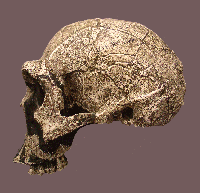
Here we have a lateral view of a chimpanzee skull on the left and a cast of the Homo erectus specimen KNM ER 3733. Can you tell the difference between the two? I thought so.
A continual improvement in stone tools assemblages and traditions from Australopithecus to Homo habilis to Homo erectus to Homo sapiens is well-documented in the geological record and books and scientific papers abound in the literature based on these data.
The section on the fossil record can only described as incompetently written at best and, given the wealth of data and literature to the contrary, intentionally misleading at worst. On this chapter alone, Of Pandas and People fails miserably as a reference work.
Part Three of my review to come shortly.
On Page 98, the authors write:
The intelligent design hypothesis is in agreement with the face value interpretation and accepts the gaps [in the fossil record] as a generally true reflection of biology and natural history. A growing number of scientists who study the fossil record are concluding that the structural differences between the major types of organisms reflect life as it was for that era.
Herein lies a major problem with the book. Who is "a growing number?" The writers do not tell us. No citation is provided at all, as if they only want us to take their word for it. Throughout the book, there is a startling lack of supporting citations and, it is my opinion that had this book been submitted to a major science publisher, it would have been returned as unpublishable until the missing citations were added. This represents sloppy work and poor attention to detail.
On page 100, we find the following:
Some scientists have arrived at this view [that ID is the correct explanation for the fossil record] since fossil forms first appear in the rock record with their distinctive features intact, and apprently fully functional, rather than gradually developing. No creatures with a partial wing or partial eye are known.
Where to start. First, the same problem mentioned above: "Some scientists." Who in God's green earth are they talking about? I don't know anyone who subscribes to this view of the fossil record. Once again, no citation.
Second, fossils do not first appear in the rock record with their distinctive features intact. As noted above, this proceeds from a standard creationist view of the fossil record that has been rebutted too many times to count.
Third, the idea that organisms would appear with partial anything demonstrates a poor understanding of how evolution works. This idea, which is the central focus of William Dembski's No Free Lunch, incorrectly assumes that organisms are "discrete combinatorial objects," in which all features of a species are regarded as having appeared at the same time. As the reviewers of that book noted, that is not how evolution works. There is not a single fossil example in which all of a particular set of features indicative of a species as a whole appeared at once.
On page 107, we get to the human fossil record. On the second side of the page, the authors write:
Before looking at the fossils recently proposed to be human ancestors, it is well to keep a few points in mind. First, comparatively few hominid fossil remains have ever been found.
What do the authors mean by "comparatively few?" How many would be "a lot?" I can think of at least 100 complete crania off the top of my head and several hundred more that are at least 50% complete. Add to this several thousands of incomplete remains and you have a fair number of fossils. Is this optimal? No, obviously we would like to have more. But it is enough to make some pretty good assessments of human evolutionary history. And more fossils are being discovered all the time. In the last five years, the origin of the human line has been pushed back two million years by the discovery of fossil remains in Chad and the Afar Triangle.
Back to the book. On page 110, they state:
Less attention has been given to the first appearance of morphologically modern humans in Africa and the Middle East, because of their recency, but these may be quite important discoveries.
Were the authors not paying attention? No fewer than five articles in Time, Newsweek, National Geographic, Science News and Scientific American were published on this topic during 1988 and 1989. And that was just in the mainstream magazines. At least twenty articles showed up in academic journals on these hominids during the same time period. Of course they were important!
On p. 111, the authors write:
The best information we can seek about man's ancestors is that which tells us, not what they looked like, but what they did and how they behaved. Of course, such information is often very fragmentary if found at all, but it is the most important data for which to search.
"...if found at all?" Archaeological information abounds. It is more common than human fossil remains. Every area of the Old World has numerous sites with continuous records of habitation that often extend sixty or seventy thousand years. In the Middle East, one of the persistent questions is how the early modern humans and the Neandertals there interacted. One of the clues is that the abundant archaeological remains at these sites indicates a similar lithic strategy. Not a single worker in this area throws up his or her hands and says, "Boy I sure wish I had more archaeological remains to work with!"
On pages 112 and 113, there is this bombshell:
Darwinists are convinced that Homo erectus was nearly human and directly ancestral to man. Design adherents, however, regard Homo erectus, as well as the other hominids discussed in this section, as little more than apes, and point instead to the abrupt appearance of the culture and patterns of behavior which distinguish man from the apes.
This statement reveals that Design adherents have adopted all of the old, tired creationist arguments about the human fossil record. The obvious, observable fact that the fossils are considerably more than apes seems to have escaped the authors of this book.


Here we have a lateral view of a chimpanzee skull on the left and a cast of the Homo erectus specimen KNM ER 3733. Can you tell the difference between the two? I thought so.
A continual improvement in stone tools assemblages and traditions from Australopithecus to Homo habilis to Homo erectus to Homo sapiens is well-documented in the geological record and books and scientific papers abound in the literature based on these data.
The section on the fossil record can only described as incompetently written at best and, given the wealth of data and literature to the contrary, intentionally misleading at worst. On this chapter alone, Of Pandas and People fails miserably as a reference work.
Part Three of my review to come shortly.
Wednesday, February 08, 2006
Darwin Day at UT
Darwin Day celebrations are in full swing now. Tonight there is a talk by the Rev. Michael Dowd called "The Gospel According to Evolution" at 7 at the Tennessee Universalist Church and tomorrow night, Dr. Timothy Berra will talk on "Charles Darwin, the Man" at the Cox Auditorium at 7. Come if you can.
Tuesday, February 07, 2006
Of Pandas and People
I have finished Reading Of Pandas and People. To recap: in the Dover School Board ruling, it was revealed that the disclaimer read to the high school ninth grade biology classes reads, in part:
Intelligent Design is an explanation of the origin of life that differs from Darwin’s view. The reference book, Of Pandas and People, is available for students who might be interested in gaining an understanding of what Intelligent Design actually involves.
How good of a reference book is Of Pandas and People? Ladies and gentlemen, it is hands down awful. I do not have the time or space to address all of the problems in the book. That has been done beautifully by Frank Sonleitner here. I will only touch on some of the major errors I found.
The first glaring error is that, while it is being used as a text that promotes an alternative to evolutionary theory, the central focus of the introduction and first section is biopoesis, the origin of life from non-life. Evolutionary theory expressly does not address this issue. Evolution is "descent with modification." It has to have something living to work with. The section on biopoesis is, therefore, irrelevant.
On page 7, the writers state:
To put it another way, breeders can produce sweeter corn or fatter cattle, but they have not turned corn into another kind of plant or cattle into another kind of animal.
Wrong. Broccoli is an intentionally bred offshoot from an ancestral cabbage possibly during the neolithic period. While they are both in the family Brassicaceae, broccoli does not interbreed with any current species of cabbage.
The writers use an analogy of a truck discovered by a native tribe that is similar in vein to that used by William Paley (although no mention of Paley's original example of the watch is given). They suggest that the natives would conclude that it is designed. This sidesteps the possibility that they might conclude no such thing. There are examples of natural features that show the appearance of design because they resemble things that we KNOW are designed. In fact, the natives might simply think that it represents a part of nature that they have never encountered before.
In the opening section in the chapter "The Fossil Record", the authors describe the nature of science. They state that, while there is science based on experiments, Darwin's theory is:
...very different from most other scientific theories. It is a theory about unique past events, events that have come and gone. However life originated in the first place, by intelligent design or spontaneous generation, however the giraffe or aardvark originated, they are not "re-originating." These are one time events.
There are several problems with this statement. Amid the persistent misunderstanding of the nature of evolutionary theory (it does not deal with the origin of life), the authors are dismissing large branches of organized, carefully practiced science, namely palaeontology, astronomy, geology, zoology and many others that don't readily come to mind. Essentially all of the "predictive" sciences. While these are mentioned in the next section, their integrity is sharply impugned. Using the analogy of a murder investigation, the authors write:
The case built on circumstantional evidence is not proof, though it may sound plausible and incriminating. Even so, the jury's belief that [the defendent] Smith is guilty may be more a product of their subjective feelings than they realize. That is why Smith is entitled to defense counsel, so that both sides of the issue can be considered.
Aside from the fact that science doesn't deal in "proof" (that is a pretty basic concept), all of the historical, or predictive sciences have always had their arguments deliberated for their veracity. That is basic to science of any kind, historical or otherwise.
Following this section, three "major" features of the fossil record are noted. They are, briefly: 1. the vast majority of known phyla appeared within a brief period of time, 2. most fossils appear to change little over the course of their history, and 3. Fossils appear fully formed and there is a "conspicuous lack of evidence of graded series of in-between fossils. Instead, numerous gaps exist throughout the fossil record."
Because so much of the rest of the book proceeds from these three observations, it is important to evaluate them.
1. This is not true. Not all phyla are present at the beginning of the Cambrian. New phyla continue to show up after the Cambrian
2. This is only partly true. There are many instances of stasis in the fossil record, but there are also many instances of persistent change over the course of a lineage and other lines that appear to change very quickly. There are other instances of anagenesis--accumulated change in one species leading to a new species.
3. This is the biggest howler in the book. Here, it is evident that the authors of this book have consulted only creationist sources for their information. The notion that there are no transitional fossils in the fossil record is the single most persistent canard in the creationist arsenal. Despite the wealth of information to the contrary, this statement and similar ones continue to appear in creationist literature and, worse, gets recycled within that literature.
Transitional forms abound. George Gaylord Simpson records an almost continuous record of species in the horses. The syapsid group of reptiles are also called "mammal-like reptiles" for exactly that reason. Fossils of these species display characteristics of both mammals and reptiles. As one moves through the mesozoic, fossils in this class have fewer reptilian characteristics and more mammalian ones.
The human fossil record is replete with transitional forms. In fact, that is the norm. Often, different researchers will disagree on where one particular fossil ought to be put (Homo erectus vs. Homo ergaster) not because of which characteristics are present, but because of a disagreement over which characteristics are more important phylogenetically.
I will continue this in the next post.
Intelligent Design is an explanation of the origin of life that differs from Darwin’s view. The reference book, Of Pandas and People, is available for students who might be interested in gaining an understanding of what Intelligent Design actually involves.
How good of a reference book is Of Pandas and People? Ladies and gentlemen, it is hands down awful. I do not have the time or space to address all of the problems in the book. That has been done beautifully by Frank Sonleitner here. I will only touch on some of the major errors I found.
The first glaring error is that, while it is being used as a text that promotes an alternative to evolutionary theory, the central focus of the introduction and first section is biopoesis, the origin of life from non-life. Evolutionary theory expressly does not address this issue. Evolution is "descent with modification." It has to have something living to work with. The section on biopoesis is, therefore, irrelevant.
On page 7, the writers state:
To put it another way, breeders can produce sweeter corn or fatter cattle, but they have not turned corn into another kind of plant or cattle into another kind of animal.
Wrong. Broccoli is an intentionally bred offshoot from an ancestral cabbage possibly during the neolithic period. While they are both in the family Brassicaceae, broccoli does not interbreed with any current species of cabbage.
The writers use an analogy of a truck discovered by a native tribe that is similar in vein to that used by William Paley (although no mention of Paley's original example of the watch is given). They suggest that the natives would conclude that it is designed. This sidesteps the possibility that they might conclude no such thing. There are examples of natural features that show the appearance of design because they resemble things that we KNOW are designed. In fact, the natives might simply think that it represents a part of nature that they have never encountered before.
In the opening section in the chapter "The Fossil Record", the authors describe the nature of science. They state that, while there is science based on experiments, Darwin's theory is:
...very different from most other scientific theories. It is a theory about unique past events, events that have come and gone. However life originated in the first place, by intelligent design or spontaneous generation, however the giraffe or aardvark originated, they are not "re-originating." These are one time events.
There are several problems with this statement. Amid the persistent misunderstanding of the nature of evolutionary theory (it does not deal with the origin of life), the authors are dismissing large branches of organized, carefully practiced science, namely palaeontology, astronomy, geology, zoology and many others that don't readily come to mind. Essentially all of the "predictive" sciences. While these are mentioned in the next section, their integrity is sharply impugned. Using the analogy of a murder investigation, the authors write:
The case built on circumstantional evidence is not proof, though it may sound plausible and incriminating. Even so, the jury's belief that [the defendent] Smith is guilty may be more a product of their subjective feelings than they realize. That is why Smith is entitled to defense counsel, so that both sides of the issue can be considered.
Aside from the fact that science doesn't deal in "proof" (that is a pretty basic concept), all of the historical, or predictive sciences have always had their arguments deliberated for their veracity. That is basic to science of any kind, historical or otherwise.
Following this section, three "major" features of the fossil record are noted. They are, briefly: 1. the vast majority of known phyla appeared within a brief period of time, 2. most fossils appear to change little over the course of their history, and 3. Fossils appear fully formed and there is a "conspicuous lack of evidence of graded series of in-between fossils. Instead, numerous gaps exist throughout the fossil record."
Because so much of the rest of the book proceeds from these three observations, it is important to evaluate them.
1. This is not true. Not all phyla are present at the beginning of the Cambrian. New phyla continue to show up after the Cambrian
2. This is only partly true. There are many instances of stasis in the fossil record, but there are also many instances of persistent change over the course of a lineage and other lines that appear to change very quickly. There are other instances of anagenesis--accumulated change in one species leading to a new species.
3. This is the biggest howler in the book. Here, it is evident that the authors of this book have consulted only creationist sources for their information. The notion that there are no transitional fossils in the fossil record is the single most persistent canard in the creationist arsenal. Despite the wealth of information to the contrary, this statement and similar ones continue to appear in creationist literature and, worse, gets recycled within that literature.
Transitional forms abound. George Gaylord Simpson records an almost continuous record of species in the horses. The syapsid group of reptiles are also called "mammal-like reptiles" for exactly that reason. Fossils of these species display characteristics of both mammals and reptiles. As one moves through the mesozoic, fossils in this class have fewer reptilian characteristics and more mammalian ones.
The human fossil record is replete with transitional forms. In fact, that is the norm. Often, different researchers will disagree on where one particular fossil ought to be put (Homo erectus vs. Homo ergaster) not because of which characteristics are present, but because of a disagreement over which characteristics are more important phylogenetically.
I will continue this in the next post.
Monday, February 06, 2006
Sky Guy on Evolution
Sky Guy in the Knoxville News Sentinel (free subscription required), tackles evolution in advance of Darwin Day here at UT. He uses exactly the illustration I often use when talking with people about evolution:
Consider, for example, gravitation. That gravity exists is a fact. What it is and how it acts is a theory. Albert Einstein expanded Isaac Newton's work, and modern developments in physics are acting to change the theory even further. But no matter how gravitational theory changes, gravity is still a fact.
The piece is a bit scattershot but informative.
Friday, February 03, 2006
"Intelligent Falling"
The Onion reports on a new take on Intelligent Design, known as "Intelligent Falling." I leave it to the reader to determine how serious the writers are.
Evolution in the Lab
Scientists have forced evolution to occur in caterpillars. This story from Fox News relates the attempts to alter the color of the caterpillars over time by subjecting them to different environmental stresses. As is noted:
Because the variations are based on temperatures, and thus in the wild would be dependent on seasons, the two types would tend to occur at different times of the year and may never meet in nature, he said.
The next step, the researchers said, is to see if the variations do indeed occur in the wild.
The researchers are quick to note also that this appears to have no selective bearing on the caterpillars, themselves. Interesting.
Sorry about the silence
Blogging has been light. I am digesting Of Pandas and People, which figured so heavily into the Dover School Board decision. So far, I am underwhelmed.
Subscribe to:
Posts (Atom)